
The short answer first, because that is what I want when I am reading one of these: in a small garage shop, the IRWIN Quick-Grip one-handed mini bar clamp is the clamp you will reach for most often, and the F-style clamp is the one you reach for when the job stops being small. I keep both within arm's reach of the bench and I have no plans to thin the herd. Thirty years of woodworking in a 12 by 20 foot converted garage outside Philadelphia taught me that the clamp question is never which one is better in the abstract. It is which one is better for the next twenty minutes of work sitting on the bench in front of you.
The IRWIN Quick-Grip 1964758 is a four pack of 6 inch one-handed mini bar clamps. Resin body, hardened steel bars, rated at 140 pounds of force, with a trigger that releases the jaws instantly and a design made for smaller workpieces and confined areas. The F-style clamp is the older, plainer tool: a steel bar, a sliding arm, and a screw handle you turn by hand until the joint closes. It is heavier, slower, and it will out-press the mini clamp without breathing hard. That is the comparison in two sentences. Everything below is the part where the actual work happens.
| IRWIN Quick-Grip Mini Bar Clamp | F-Style Screw Clamp | |
|---|---|---|
| One-handed operation | Squeeze the trigger with one hand while the other hand stays on the workpiece | Two hands needed, one to hold the bar and one to turn the handle |
| Clamping force | Rated at 140 pounds of force, plenty for small parts and edge work | A screw handle keeps pressing well past what the mini clamp can give |
| Reach and throat depth | 6 inch clamp built for edges, corners and small assemblies | Long bars and deep throats get into the middle of a wide panel |
| Speed on a glue-up | Trigger sets and trigger releases, no spinning, reposition in seconds | Every clamp needs several turns on and several turns off |
| Small and odd shaped parts | Light head does not tip a birdhouse wall or a thin offcut out of place | Heavy head and long bar pull small work out of square |
| Storage in a 12 by 20 shop | Four 6 inch clamps fit one shallow drawer or one pegboard hook | Long bars eat wall space you probably do not have |
| Abuse on a concrete floor | Tough resin body with hardened steel bars and a full lifetime guarantee | All steel, nothing to crack, survives being kicked across the shop |
| Best for | Boxes, cutting boards, edge banding, drawer fronts, repair jobs | Wide panels, carcasses, veneer pressing, deep joints |
Where the IRWIN Quick-Grip Wins
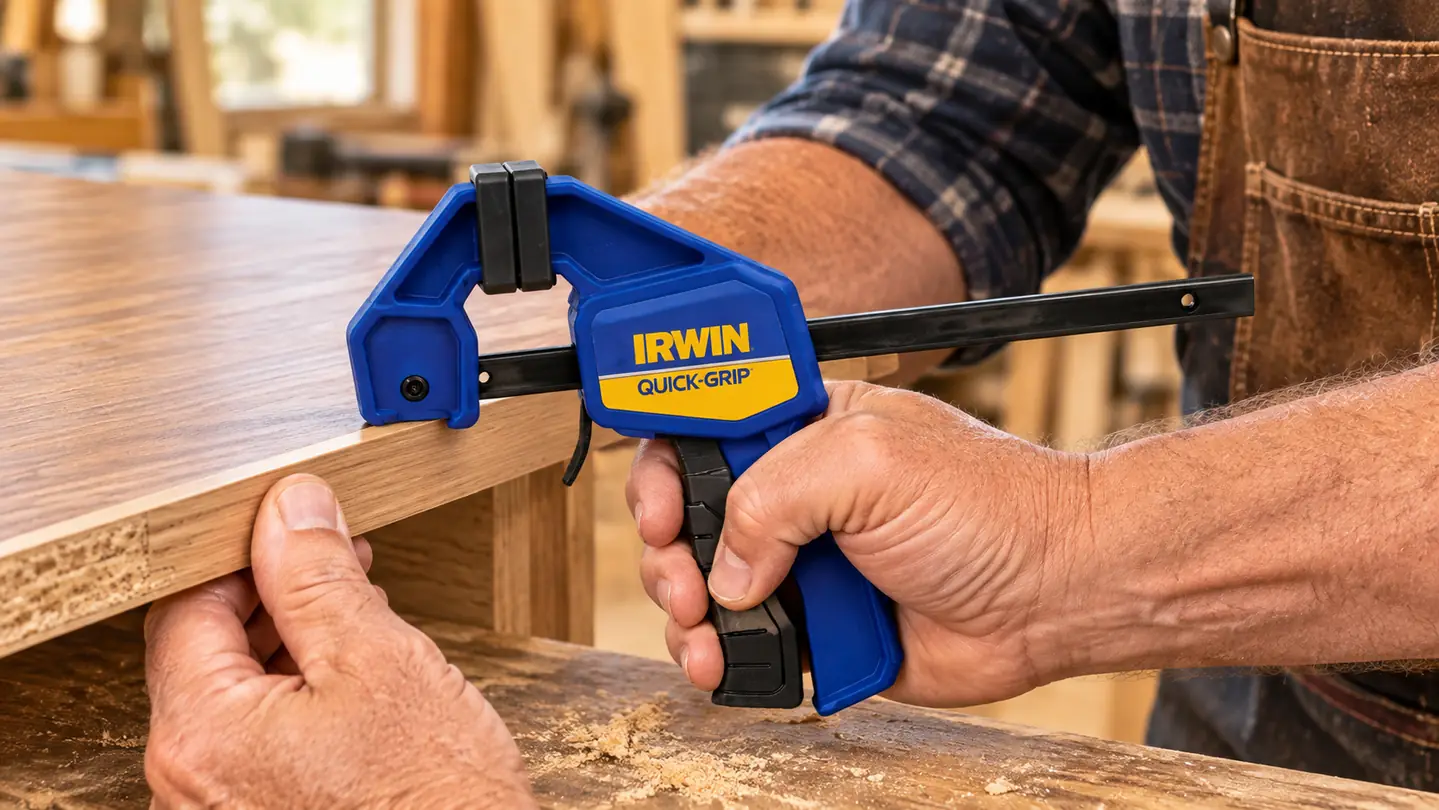
The one-handed trigger is not a convenience feature. It is the reason the clamp gets used at all. On a glue-up, one hand holds the joint closed and the other squeezes the trigger, and the clamp is set before the glue starts to grab. With a screw clamp both hands are busy on the tool and nothing is holding the workpiece, so a corner slides a sixteenth of an inch while you are turning a handle. I have chased that sixteenth of an inch more times than I care to admit. Multiply it by eight clamps on a cutting board and you have a panel that is out of square before you ever reach for the straightedge.
The mini clamps also fit where the big ones cannot go. Edge banding on a bookshelf side, a small box mitre, a birdhouse wall while the glue sets, a thin offcut that needs holding against a fence. Confined areas are exactly what these were built for, and a 6 inch clamp with a resin body gets into a corner without its head knocking the assembly sideways. Four of them take up one shallow drawer, which in this shop is the difference between owning clamps and owning a pile of clamps. The trigger release means a slipped joint can be loosened, fixed and re-clamped in seconds instead of turns, and that matters once the glue is open.
Last March I built eight small birdhouses in one afternoon with the wood stove going and the garage door down against the wind. Each one is four walls and a floor, so that is five glue joints per house, forty joints total, and every single one of them was set with a 6 inch mini clamp. Two clamps per house let me glue the walls in one pass, square the box by eye against the bench edge, and move on while the previous one sat. I did not touch a screw clamp all afternoon. If I had been working with the F-style clamps I would have set up maybe two houses before the light went, because the whole job was reach, set, release, reach, set, release, and the trigger is built for exactly that rhythm. That afternoon is the clearest case I can make for buying the small clamps first.
Where F-Style Clamps Win
Force and reach. The IRWIN mini clamp is rated at 140 pounds of force, and that is plenty for a cutting board, a small box or a drawer front. It is not plenty for a 24 inch wide hardwood panel where the caul bows and the middle of the joint stays open. A screw clamp keeps turning after the mini clamp has given everything it has. When I laminated the cherry for a blanket chest, the F-style clamps did the pressing and the mini clamps held the cauls and the alignment blocks. That division of labor has not changed in thirty years, and I do not expect it to.
The other thing the F-style does better is reach. Long bars span a whole carcass, and a deep throat gets past the face frame to the joint behind it. I have pulled a cabinet box together with four 36 inch screw clamps and there is no version of that job where a 6 inch mini clamp helps. The bar lengths are the point, not the mechanism. An all-steel clamp also takes punishment. It can be dropped on a concrete floor, kicked under the bench and left in the cold by the wood stove without complaint. The resin body on the mini clamp is tough and it carries a full lifetime guarantee, but it is still resin, and I do not test that on purpose.
The clamp that lives on my bench, not in a drawer
Four 6 inch one-handed mini bar clamps with hardened steel bars, 140 pounds of rated force, and a trigger that lets go the instant you squeeze it. This is the set I reach for first on nine jobs out of ten.
Amazon Check Today's Price on Amazon →The 140 Pound Question
Rated force is the number people argue about and it is the number I trust least. 140 pounds on a 6 inch clamp is real, and it is enough to close a joint and hold it while the glue sets. What it will not do is straighten a cupped board or pull a twisted panel flat. Neither will a screw clamp, honestly, but the screw clamp lets you keep leaning on it anyway, and that can be worse. Overtightening is how a glue joint gets starved, with the joint line squeezed dry until there is nothing left between the two faces. I did that to a maple panel years ago and I still think about it when I pick up a handle.
What matters more than the rating is how evenly the pressure goes on. On a cutting board I alternate clamps above and below the panel, snug them in order, then come back around for a final light pass with a hand on the joint to feel for movement. The mini clamps are light enough that I can carry four of them to the bench in one hand and set them all in under a minute. The F-style clamps take a second trip and a bit more patience. That difference in setup time is exactly why the small clamps get used on the small jobs instead of dragging the big clamps out for everything.
The way I check a joint is simple and it costs nothing. After the last clamp is snug I put two fingers on the joint line and try to rock the pieces against each other. If I feel movement I add a clamp or move one over, and I do it before the squeeze-out starts to skin over. With the trigger clamps that check takes ten seconds, because I can set and release with the same hand that is holding the work. With a screw clamp I am usually doing that check with a turning handle in my palm and one eye on the clock, and I have talked myself out of fixing a joint that way more than once. The clamp you can adjust quickly is the clamp whose joints actually get adjusted.
A Glue-Up in a 12 by 20 Shop, Start to Finish
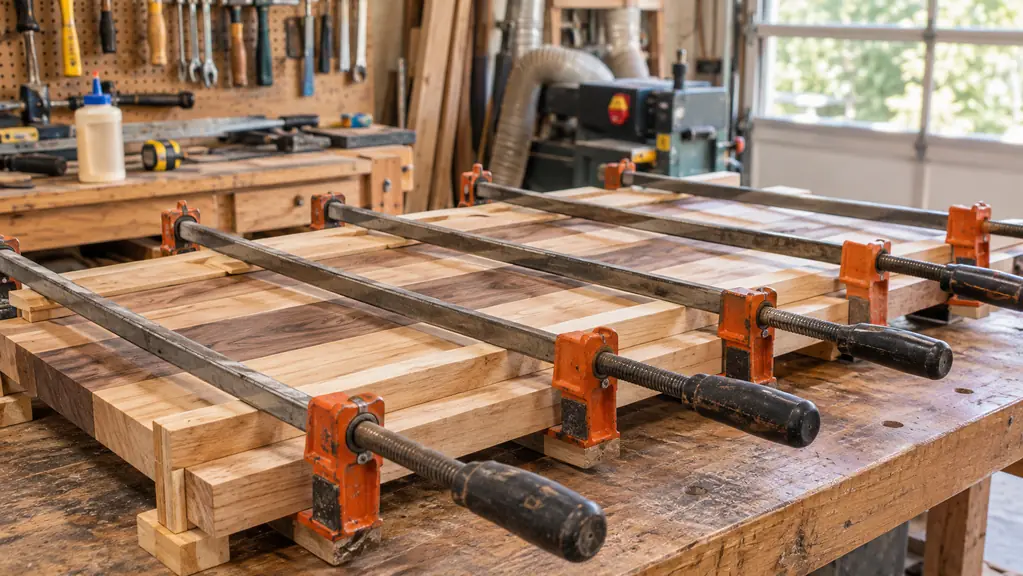
A typical Saturday here is a cutting board, and that board is a fair test. The last one I glued up was in November, nine strips of hard maple and walnut, glued into an 11 inch wide panel. I lay the strips out dry, tape them into a bundle and check the fit. Then the glue goes on, the strips go together, and the mini clamps go on from the ends inward. Four 6 inch clamps will hold a board up to about a foot wide if I use cauls, and the cauls are two scraps of oak with packing tape on the faces so they do not glue themselves to the workpiece. The trigger release lets me move a clamp one strip over without loosening anything else, which sounds like a small thing until you have done it the other way with a handle.
Same shop, different Saturday: an end table top, 20 inches wide, glued from three boards. The mini clamps hold the alignment and the cauls. The F-style clamps do the pressing, three across the top and three across the bottom, alternating. If I only owned the mini clamps I would still get that top glued, but I would fight the panel for the whole open time and I would likely have a glue line to fix later. If I only owned the F-style clamps I would get it done too, and I would spend twice as long setting and releasing them. That is the honest trade, and it is why both hang in this shop.
Four 6 inch mini clamps at 140 pounds of force handle every cutting board I build. The 20 inch panel is where the F-style earns its keep.
What I Got Wrong Early On
I bought my clamps backwards. My first real set was four long F-style clamps, because that is what the books showed, and I used them for everything for about five years. Small boxes, thin stock, edge banding, all of it under a heavy steel bar with a screw handle. I crushed the edge of a walnut jewelry box because I had no light touch with a screw clamp and no scrap between the jaw and the work. That box became a box with a rounded corner I did not plan, and I gave it to Carol rather than throw it out. I also skipped a lot of small glue-ups, because dragging out four long clamps for a two minute job felt like more trouble than the job was worth.
The mini clamps fixed both of those problems. They are light enough that setting up for a five minute glue-up is not a decision, and the trigger gives me a feel for pressure that a screw handle never did. If I were starting over with the shop I have now, I would buy the four pack of 6 inch one-handed clamps first, use them for a year, and only then work out which length of F-style clamp I actually needed. I would have saved money and shelf space, and I would have glued more things instead of putting them off. That is the advice I give anyone who asks me about clamps at the lumber yard.
Who Should Buy Which
Buy the IRWIN Quick-Grip mini set first if your work is boxes, small case goods, cutting boards, birdhouses, toys for the grandkids, drawer fronts, edge banding and neighbor repair jobs. If your bench sits against a wall and you are always reaching into a corner, the one-handed trigger is the whole argument. Four clamps, one drawer, 140 pounds of force each, and a lifetime guarantee behind them. For a hobbyist in a garage, that set will carry most of a year of work before you need anything longer.
Buy F-style clamps if you are gluing panels wider than about 12 inches, building cabinet carcasses, pressing veneer, or clamping anything where the joint sits deep behind a face frame. Get them in a couple of lengths rather than one long one, because a 36 inch clamp on a 12 inch job is clumsy and heavy and you will stop reaching for it. Most small shops settle at two or three F-style clamps in the 24 inch range and a dozen mini clamps, and that ratio feels about right to me. The order matters more than the label on the bar: start with the clamp you will actually pick up.
Start with the set that fits the shop you actually have
A 6 inch one-handed bar clamp handles cutting boards, boxes, edge banding and repairs without eating bench space. Four in the pack means you can set a whole assembly in one pass.
Amazon See the 4-Pack on Amazon →