
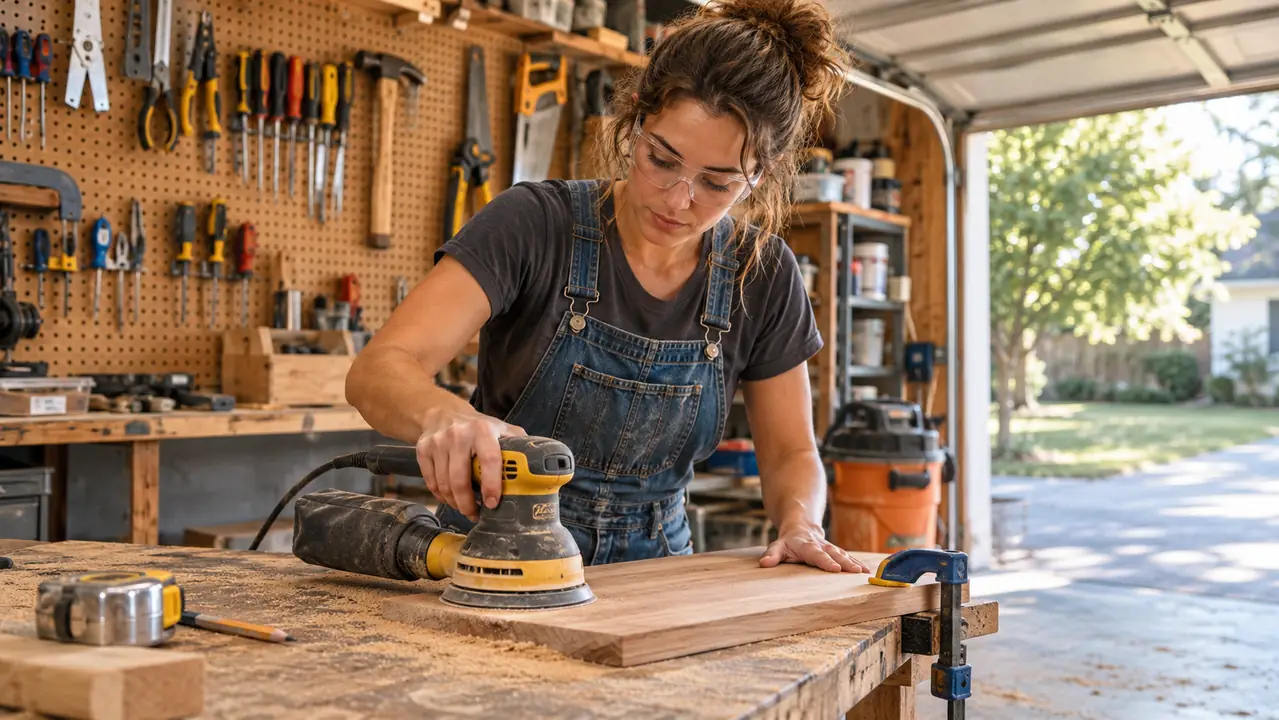
Ten years ago I bought a quarter sheet sander because it was the cheapest thing on the shelf. It lasted three cutting boards. The paper slipped out of the clamps, the corners dug grooves into anything softer than oak, and after twenty minutes my hands were still buzzing an hour later. I gave it to a neighbor and went back to sanding by hand, which is a young man's game, and I was not a young man even then. What I needed was a random orbital sander. What I needed just as much was one that would sit on a shelf in a twelve by twenty garage without complaining about running for two hours on a Saturday.
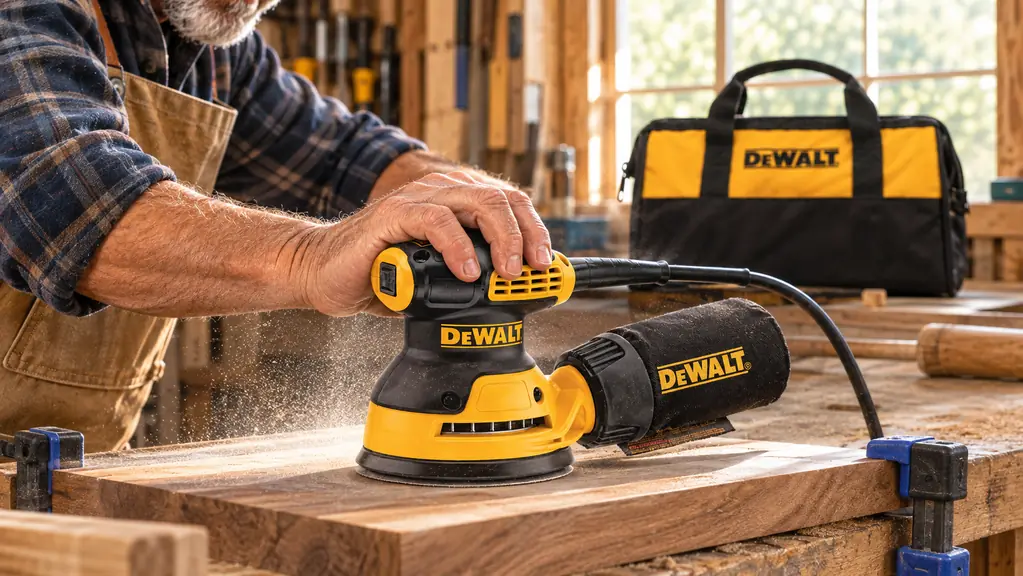
That is the hole the DEWALT DWE6421K fills. It has been the sander on my bench for the better part of a year, and it is the tool I reach for before anything else with a cord on it. The spec sheet is not exotic: a 5 inch pad, a 3.0 amp motor spinning it at 12,000 OPM, corded, 120 volts, and a body that measures roughly ten inches long, seven wide and six tall. DEWALT has been building this shape of sander for a long time and it shows. The dust bag locks on with one hand, the switch is sealed against dust, and there is rubber over-molding everywhere your palm and fingers actually land. Five thousand six hundred reviews at a 4.7 average is not proof of anything on its own, but it is not nothing either.
The Quick Verdict
A short, steady, dust-sealed 5 inch orbital that has handled every board I have put under it. Buy it if you sand in a small shop and want one tool that does not need babysitting. Skip it if you need to slow the pad down for delicate finish work.
Amazon Check Today's Price →The sander that earned its shelf space in a one-car garage
Corded, 3.0 amp, 12,000 OPM, 5 inch pad, and a dust bag that locks on with one hand. Check today's price and the current kit contents on Amazon.
Amazon Check Today's Price on Amazon →How I've Used It
The first job was a maple cutting board that had gone grey from too many years next to the sink. I clamped it to the bench, started at 80 grit and worked up through 120 and 220. The sander ran for about forty minutes across three sessions and never once bogged down. That matters in a small shop because there is no room for a second tool sitting out. If the first one stalls, you stop working and go find the reason.
Since then it has been on an end table in walnut, a set of bookshelves for my daughter Jen's place, and a cherry blanket chest that is the most ambitious thing I have built. The chest took the most sanding, maybe six hours total spread across two weekends, and the tool never got hot enough that I felt I needed to set it down and let it cool. My grandson Tyler, who is twelve and helps on weekends when he is not in school, ran it across a pine birdhouse with supervision and safety glasses on. It is light enough and short enough that a kid can keep it flat, and keeping it flat is most of the battle.
The repair jobs are where it earns its keep in a different way. A neighbor brought over a built-in shelf that had water damage on one end. I could not take the shelf out of her house, so I took the sander to it. The short body let me get the pad into a corner where a taller tool would have hit the wall. DEWALT lists the shorter height as a feature and I always read that as marketing until I actually needed it.
The other thing I use it for is levelling. When two boards come out of a glue-up a hair out of line, a few passes with 80 grit will bring them flush faster than a hand plane will if you are not confident with a hand plane. I am not confident with a hand plane on a curved glue line. The sander does not care about my confidence.
What the Numbers Actually Mean at the Bench
Three amps and 12,000 OPM is not a fire-breathing number. It is a number that says this tool will keep the pad moving under load without stalling on you. Stalling is what you feel with a weak sander. You lean in, the pad slows, and you end up pressing harder to compensate, which puts dips in the wood. I have not had that problem here. When I lean, the pad keeps turning and the wood comes off evenly, and I finish with a board that is flat instead of a board I have to fix.
The separate counterweight is the spec I did not understand until I had used a sander without one. The tool vibrates, obviously, but the vibration is contained in a way that lets me run it one-handed along a rail while my other hand holds the workpiece steady. After a long session my hands feel tired, not numb. That is a real distinction, and it is the difference between a tool you use for an hour and a tool you use all afternoon.
The 5 inch pad is the practical middle. A larger pad covers more ground per pass, but it also needs more room around the workpiece and more clearance on the shelf. In a shop that is twelve feet wide, 5 inches is the size where you can still get into a corner and still put the tool down without rearranging the bench. If I had a twenty by thirty shop and a full-time furniture habit I might argue for the bigger one. I do not have that shop.
Dust Collection: Better Than I Expected, Not a Shop Vac
The dust bag is the part of this tool I expected to hate. I have a shop vac and a portable dust collector, and my instinct is that any bag smaller than a pillowcase is decoration. But the bag on this sander is genuinely useful. It locks on with one hand, which sounds like a small thing until you are holding the tool in one hand and reaching for the bag with the other. The seal is decent, and a good share of what comes off a board ends up inside it instead of on my glasses.
It is not a replacement for real dust collection and I would not pretend otherwise. The bag fills. On a long session with 80 grit it fills faster than you would like, and emptying it is a small chore that kicks a little dust back into the air. I empty mine over the trash barrel outside the garage door. But the difference between a bag that catches most of the dust and no bag at all is the difference between a shop you can sweep in five minutes and a shop you have to blow out with a leaf blower.
The sealed switch is the other half of that story. Dust is what kills switches on sanders. It gets inside, the contacts gum up, and one day the tool does not start. DEWALT sealed this one, and after months of running it in a garage that is dusty by definition, the switch still clicks cleanly and starts on the first press every time. That is not a dramatic observation. It is the kind of thing you only notice when it stops being true.
Months Later: What Wore and What Didn't
I keep a mental list of what breaks on a sander, and it is usually the pad, the cord, or the switch. The pad still grabs paper firmly. The cord has not developed a soft spot where it enters the housing, which is where cords usually fail. The switch is fine. The bag has held up. The carrying bag that comes in the kit has done what a carrying bag should do, which is hold the tool and the dust bag without the zipper separating.
The one thing I have had to adjust is my own habit of setting the tool down on its side while it is still spinning. The pad will scuff whatever it lands on, and I have a mark on my bench top to prove it. That is not the tool's fault, but it is worth saying out loud, because a spinning pad does not know the difference between a workpiece and a bench top.
The warranty is three years limited. I have not had to use it, and I hope not to. But it is worth knowing the number before you buy, because a sander that gets used hard in a hobby shop can outlive a shorter warranty without anyone being at fault.

The Honest Tradeoffs
This is a single-speed sander. The switch is on and off and there is nothing in between. For stripping a board and levelling a glue-up, that is exactly what you want. For finish work, where you might want to slow the pad down so you do not burn through thin stock, it is a limitation. I work around it by stepping up my grits and keeping the tool moving, which is what you should be doing anyway, but I would be lying if I said I never wished I could dial it back.
It is corded, which in a garage shop is the right answer and in a driveway is not. There is no battery to run down on a Saturday, and no battery to buy in five years either. But you are tethered, and if you are sanding something large out in the yard you will want an extension cord that can carry the load without warming up.
The bag, again. It is good for a bag its size and it is not a dust extractor. If you are sanding in a basement or a room attached to the house, you want real collection, and that means a different setup. In a detached garage with the door open, the bag is enough.
And the switch is a plain on and off with nothing fancy behind it. I list that as a tradeoff rather than a fault, because what you are buying here is a motor and a pad, and the money went there instead of into electronics that would need their own repair someday.
Setting It Up in a Small Shop
One of the reasons this sander stayed on the bench is that it does not demand a system. I clamp the workpiece down with a couple of hold-downs, plug the tool into the outlet above the bench, and go. There is no hose to drag around. When the dust gets finer and starts hanging in the air, I open the garage door and put a box fan in the doorway behind me. That is not a dust collection strategy, it is a small shop workaround, but it keeps the air clear enough to work in.
Storage matters more than people admit. The kit comes with a carrying bag, and the tool plus the dust bag plus the carrying bag takes up about the footprint of a small toolbox. It goes on the shelf above the bench, which is the only shelf I have. A tool that needs its own drawer does not stay in my shop.
The other small-shop note is the bench itself. A sander pushes the workpiece around. I learned that the hard way on the first cutting board, which walked halfway across the bench before I noticed. A strip of shelf liner under the board, or two clamps, fixes it. That has nothing to do with DEWALT and everything to do with a bench that is not bolted to the floor.
What I Liked
- 3.0 amp motor keeps the pad moving under load, so you stop leaning on the tool
- Separate counterweight keeps vibration low enough to run one-handed
- Short body gets the pad into corners a taller sander cannot reach
- Dust-sealed switch still clicks cleanly after months in a dusty garage
- One-handed locking dust bag catches more than you expect
- 5 inch pad is the right size for a twelve by twenty shop
Where It Falls Short
- Single speed. No way to slow the pad for delicate finish work
- Dust bag fills fast on long sessions with coarse grit
- Corded only, so you are tied to an outlet
- Setting it down while the pad is still spinning will scuff your bench
I ran it roughly six hours across two weekends on a cherry blanket chest and it never got hot enough that I felt the need to set it down.
Who This Is For
This is for the person sanding in a garage or a spare room with a bench, a shop vac and not much else. Cutting boards, small tables, shelves, toys, repair jobs. You want one sander that starts every time, does not tire your hands out, and fits on a shelf when you are done. You are not running a production shop and you are not sanding veneered aircraft parts. The DEWALT DWE6421K does that job without asking anything of you.
It is also a reasonable first orbital for someone moving up from hand sanding or from a quarter sheet sander. The learning curve is short. Keep it flat, keep it moving, let the tool do the work, and do not press. Everything about the design pushes you toward that, from the low body to the way the weight sits in your palm.
Who Should Skip It
Skip it if you need variable speed. If your work involves veneer, thin inlays, or finish work where a fast pad will burn through in a heartbeat, a single-speed tool will fight you and you will end up buying twice. That is an honest limitation, and it is the main reason someone would look at a different machine.
Skip it if you sand in an attached room and cannot open a door. The bag is good but it is not a dust extractor, and fine dust inside a house is a health problem, not a nuisance. And skip it if you need to work away from an outlet, because there is no battery here and there never will be.
The last group is anyone who wants a bigger pad. If you have the space and most of your work is large panels, a bigger sander will cover ground faster. I do not have the space, so I am not the person to argue with you about it.
One sander, one shelf, no babysitting
Corded 3.0 amp, 12,000 OPM, 5 inch pad, a dust bag that locks on with one hand, and a three year limited warranty. Check today's price on Amazon.
Amazon Check Today's Price on Amazon →