
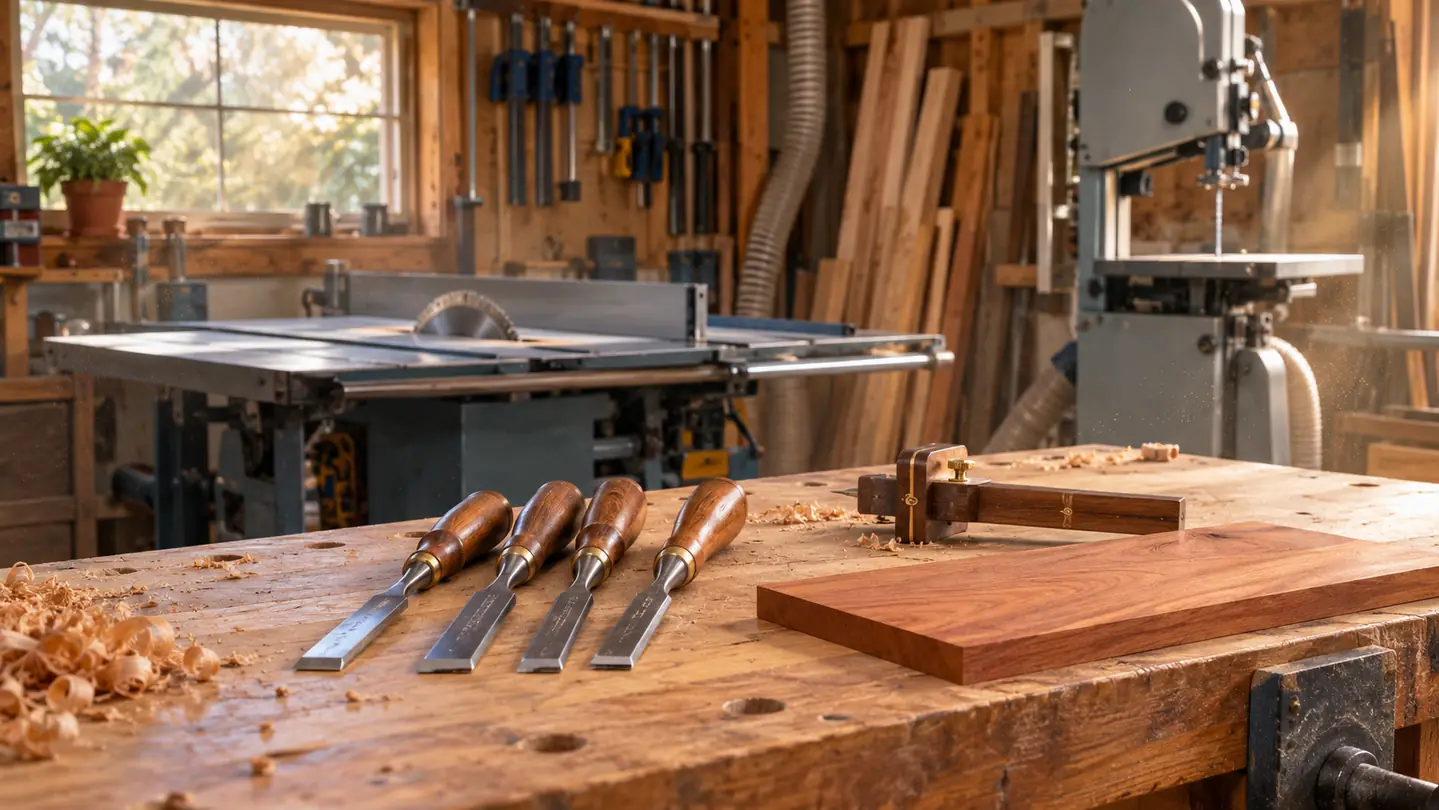
There is a day in every home shop when you stop buying tools and start buying the tools you actually reach for. For me it was a Saturday about eleven years ago, hunched over a small cherry box, trying to clean out a hinge mortise with a utility knife because I did not own a chisel worth sharpening. The knife slipped. There is still a gouge in that lid. I keep the box on a shelf above the bench as a reminder that the wrong tool ends up costing you the project.
What sits on the bench now is a HURRICANE 4 piece wood chisel set. Drop forged CR-V steel, 25 degree bevel edges, PVC handles, blade guards, and a case. The sizes are 1/4 inch, 1/2 inch, 3/4 inch, and 1 inch. Nothing about it is fancy and that is the point. My shop is a one car garage, roughly twelve by twenty feet, with a table saw, a band saw, a shop vac, and a wood stove that eats a corner all winter. Anything that lives in there has to earn its footprint. This set earns about six inches of a drawer.
Four chisels, one drawer, no more working around the job
If your bench still has a utility knife where a chisel ought to be, this is the simplest fix I know. Four sizes, guards on the blades, a case for the drawer.
Amazon Check Today's Price on Amazon →The bevel edge lets you pare straight into a corner
A bevel edge chisel has a flat back and one ground bevel on the face. That geometry is what lets you lay the flat back against a surface and slice sideways into a right angle without the tool fighting you. The HURRICANE set is ground at 25 degrees, a sensible all-round angle for softwood, hardwood, and the laminated pine I keep around for jigs. I use the 1/2 inch most for this, walking the back along the wall of a mortise and taking light shavings until the hinge sits flush.
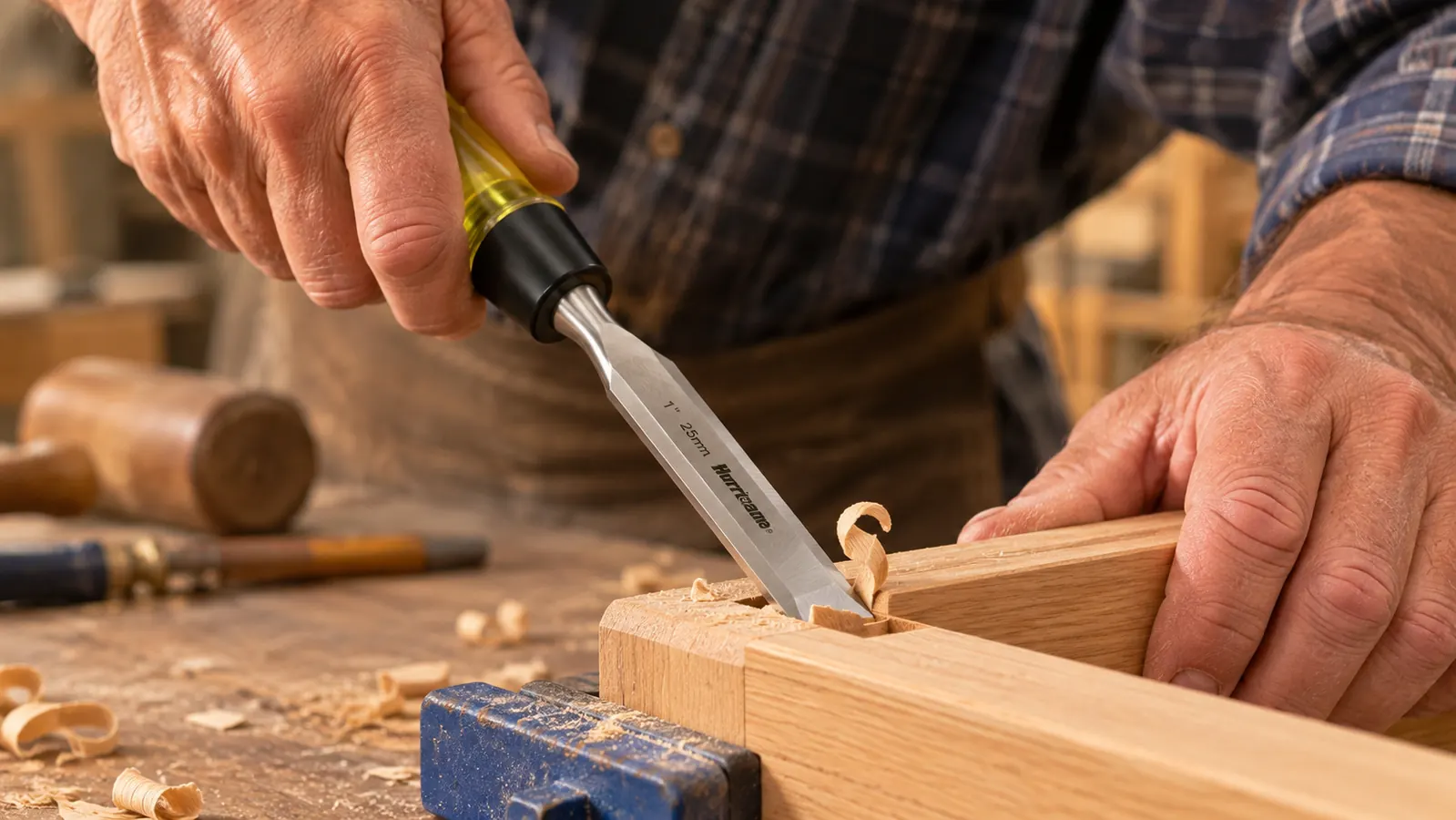
Four sizes cover the joints a home shop actually cuts
You do not need eleven chisels. You need a narrow one for small mortises and tight corners, a middle one for general paring, and a wide one for slicing across a board face. The 1/4, 1/2, 3/4, and 1 inch spread does exactly that. The 1/4 inch handles hinge leaves and the little stopped cuts on birdhouses. The 1 inch is what I reach for when paring end grain on a cutting board or trimming a dowel plug flush on an end table apron.
Drop forged CR-V steel holds an edge through a full session
The blades are drop forged chromium vanadium steel with heat treated edges. At the bench that means the edge survives a normal evening of paring instead of turning into a butter knife halfway through. I sharpen mine about every third project and I am not gentle with them. Hard maple dulls an edge faster than pine, which is true of any steel. The difference is that these come back on a stone without a fight, and a chisel that sharpens easily gets sharpened.
Blade guards mean no roll, no rack, no wasted drawer space
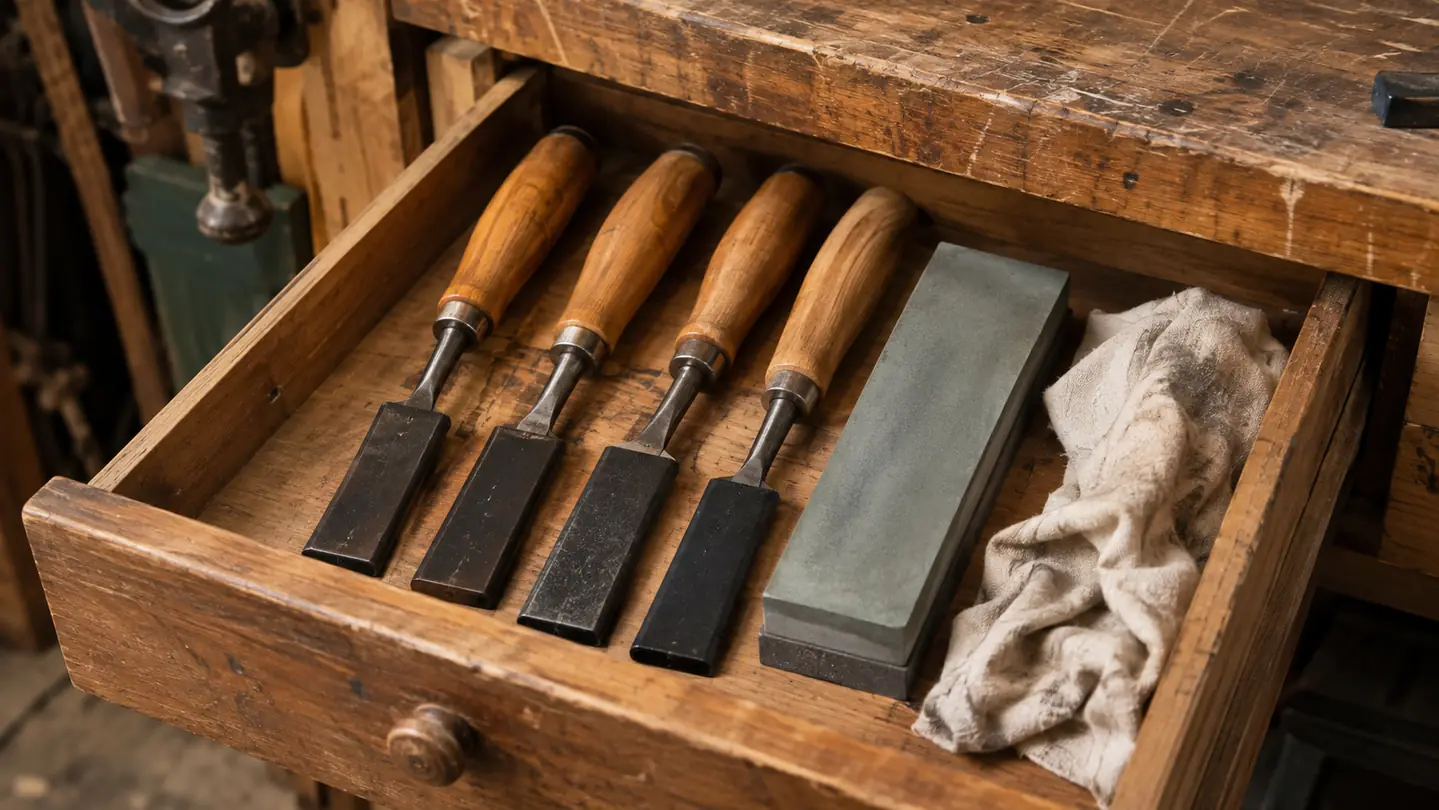
Every chisel in the HURRICANE set ships with a blade guard, and the guards are why the set can live in a drawer instead of a wall rack. In a twelve by twenty shop, wall space is spoken for. I keep the four chisels in a shallow drawer under the bench next to the marking tools, guards on, edges safe. If you have ever reached into a drawer and found an unguarded edge with your knuckle, you know why this matters. The set also comes in a case if you would rather keep it together.
PVC handles shrug off a concrete floor
I knocked the 3/4 inch off the bench last winter onto the garage slab. It bounced, I said a word, and I picked it up expecting a split handle. Nothing. The PVC handles are not pretty the way a turned hardwood handle is pretty, but they take a hit and stay tight. A tool that survives being dropped is a tool you stop being nervous about, and nervous hands make bad cuts.
I sharpen mine about every third project and I am not gentle with them. A chisel that sharpens easily gets sharpened, and that is the whole game.
Paring end grain on cutting boards stops the tear out
End grain cutting boards are most of what I build for family and neighbors. The glue up is never perfectly flush and a block plane will sometimes tear end grain instead of slicing it. A sharp 1 inch chisel, worked in from the edges toward the middle in light passes with both hands on the tool, takes those glue lines down clean. I learned it the hard way on a walnut board that is now a shop cutting board.
Hinge mortises without dragging out the router
For a single small box or a birdhouse door, setting up a router takes longer than cutting the mortise by hand. The 1/4 inch and 1/2 inch chisels take one down in about ten minutes with a marking gauge line and a mallet. Score the perimeter, waste out the middle, then pare to the line. The trick is not rushing the last pass. Everything below the line comes off a hair at a time.
Cleaning up joinery on shelves and end tables
Machine cut joinery almost always needs hand work before glue up. A dado a few thousandths proud, a tenon shoulder that will not seat, a rabbet with a ridge down the middle. A 3/4 inch chisel takes all of that off in a pass or two. When I am building bookshelves the 3/4 inch stays out on the bench, because it is the size that fits the dados I cut for fixed shelves. No setup, no jig, just a tool already in reach.
A set you can learn to sharpen on without flinching
Most dull chisels in home shops belong to people who bought one expensive chisel and are afraid to touch it to a stone. Four chisels in the HURRICANE set is a much easier thing to practice on. I learned on this set, on a combination stone, with a cheap honing guide the first year and freehand after that. If you roll an edge, you grind it back and start again. That is how the skill gets built, and it does not get built on a tool you are scared of.
Six inches of drawer and you are done
The whole argument comes down to footprint. Four chisels plus guards fit in a drawer about the size of a shoebox, and the case is small enough to sit on a shelf if you prefer. In a shop where the table saw and band saw already own the floor, a tool that lives in a drawer and solves a dozen different problems is worth keeping. Mine have lived in that drawer for years now. I have never once wished I had fewer chisels.
What I'd Skip
A few things I would not buy, and one mistake I made twice. I would skip the two inch chisel for a home shop. It is wide enough that keeping it flat takes real technique, and I have used mine maybe four times in thirty years, mostly on door hinges. I would skip the eight piece bargain sets, because four good sizes beat eight indifferent ones and you will stare at the extras. I would skip the wall rack too if your shop looks like mine. The mistake I made twice was buying a set before I owned a way to sharpen it, which turns decent steel into a drawer ornament inside a month. Get the stone or the guide at the same time. Your first hour with a dull chisel is the hour you decide hand tools are not for you, and that is a shame, because it was never the tool's fault.
Start with the four sizes you will actually use
Guards on, case included, 25 degree bevels out of the box. Sharpen them once, keep them in a drawer, and stop working around the jobs that need a chisel.
Amazon Check Today's Price on Amazon →