
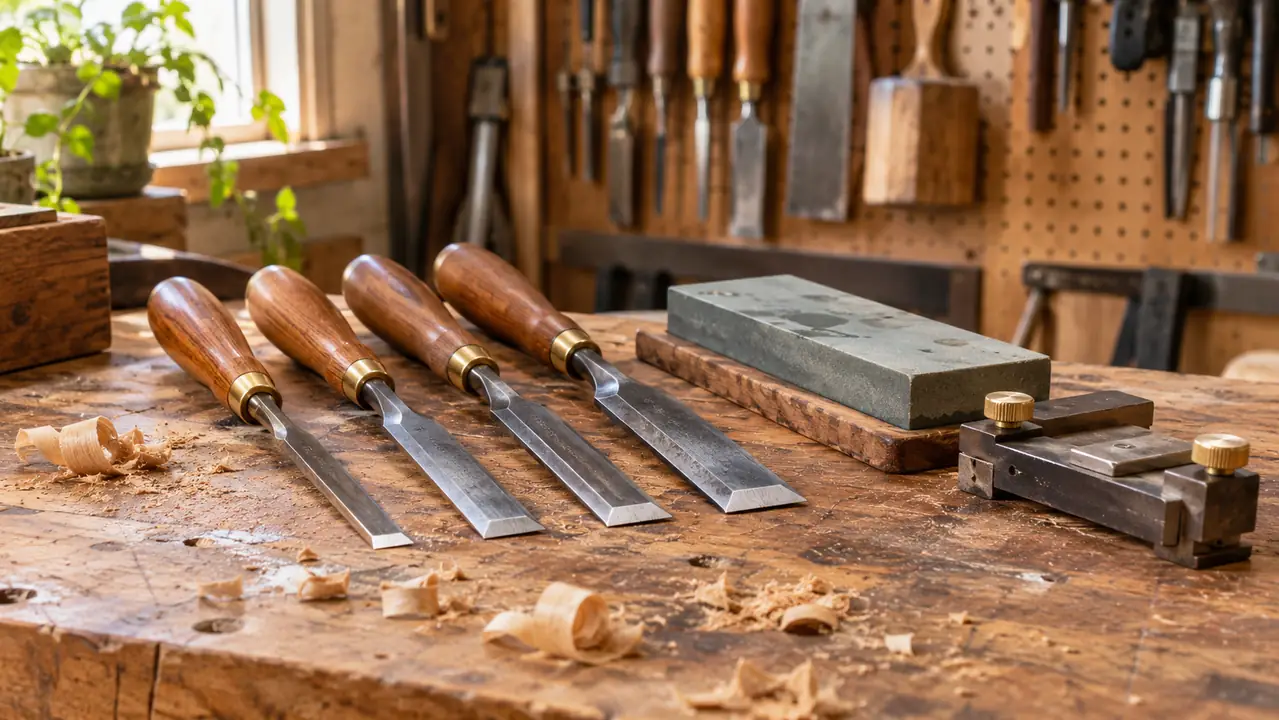
There is a moment in a home shop when the chisel you own stops being good enough and starts being the reason a joint gaps. Mine came on a cherry blanket chest, with a half inch chisel I had sharpened so many times the bevel had gone round. I bought the HURRICANE 4 piece wood chisel set that week, mostly because it was the set I could put on the bench without a long conversation about the budget. A couple of years later I added a Narex set. Both are still hanging on the rack over my bench, and I reach for different ones depending on the job in front of me.
So here is the short answer before the long one. If you are outfitting a first bench in a garage shop and you need four working sizes without straining a hobbyist budget, the HURRICANE set is the sensible buy. If you are already building furniture and you want chisels that arrive flatter on the back and hold an edge longer in white oak, the Narex set is the step up that earns its place. Neither one is a mistake. They answer different questions.
| HURRICANE 4 Piece Set | Narex 4 Piece Set | |
|---|---|---|
| Cost tier | The entry point. Four working sizes, blade guards and a case on a hobbyist budget. | Noticeably more for the same four sizes. |
| Steel and bevel | Drop forged CR-V steel, heat treated edges, 25 degree bevel. | Chrome vanadium steel with a 25 degree bevel, from a Czech maker that has been grinding chisels a long time. |
| Sizes in the set | 1/4, 1/2, 3/4 and 1 inch. | The same four sizes, and available in larger sets if you want them. |
| Handles | PVC with a regular grip. Wipes clean and does not soak up oil or finish. | Stained beech with brass ferrules. Feels like a traditional bench chisel. |
| Back flatness out of the box | Needs real lapping on a coarse stone before it will pare clean. | Flatter sooner, so less time at the coarse stone. |
| Edge holding in hardwoods | Fine in pine and poplar, wants touch ups in white oak. | Keeps a paring edge longer in oak and maple. |
| Edge protection | Blade guards and a fitted case included. | Arrives in a cardboard box, so a roll or a rack is on you. |
| Best for | A first bench, a second set, or a shop where other people handle the tools. | The set you keep sharp and reach for on furniture work. |
How I Ended Up With Both
A note on that table. I scored each row on how I actually use these chisels in a twelve by twenty foot garage shop, not on a spec sheet. The rows where the Narex set wins are rows I feel in my arms and my hands, and I am not going to pretend otherwise to make a budget tool look better than it is.
The HURRICANE set came first because I needed four sizes and I needed them to be usable that weekend. The set is 1/4, 1/2, 3/4 and 1 inch, drop forged CR-V steel, heat treated edges, a 25 degree bevel, PVC handles, blade guards and a case. That is a plain description of a plain tool, and I mean that as a compliment. I lapped the backs and honed the bevels on a water stone the first Saturday and put them to work on a set of bookshelves.
The Narex set came later, after a neighbor asked me to repair a white oak table and I spent more time touching up an edge than I did paring the mortise. Narex is a Czech maker with a long history in chisels, and the set I bought carries the same four sizes with stained beech handles and brass ferrules. The difference was not dramatic on the first cut. It showed up on the fortieth.
What I will not do is tell you the inexpensive set is junk. It is not. I have cut a lot of mortises with the half inch HURRICANE chisel and it is still in the rack and still taking an edge. What I will tell you is where each set stops being the right tool, and that is the rest of this article.
Where HURRICANE Wins
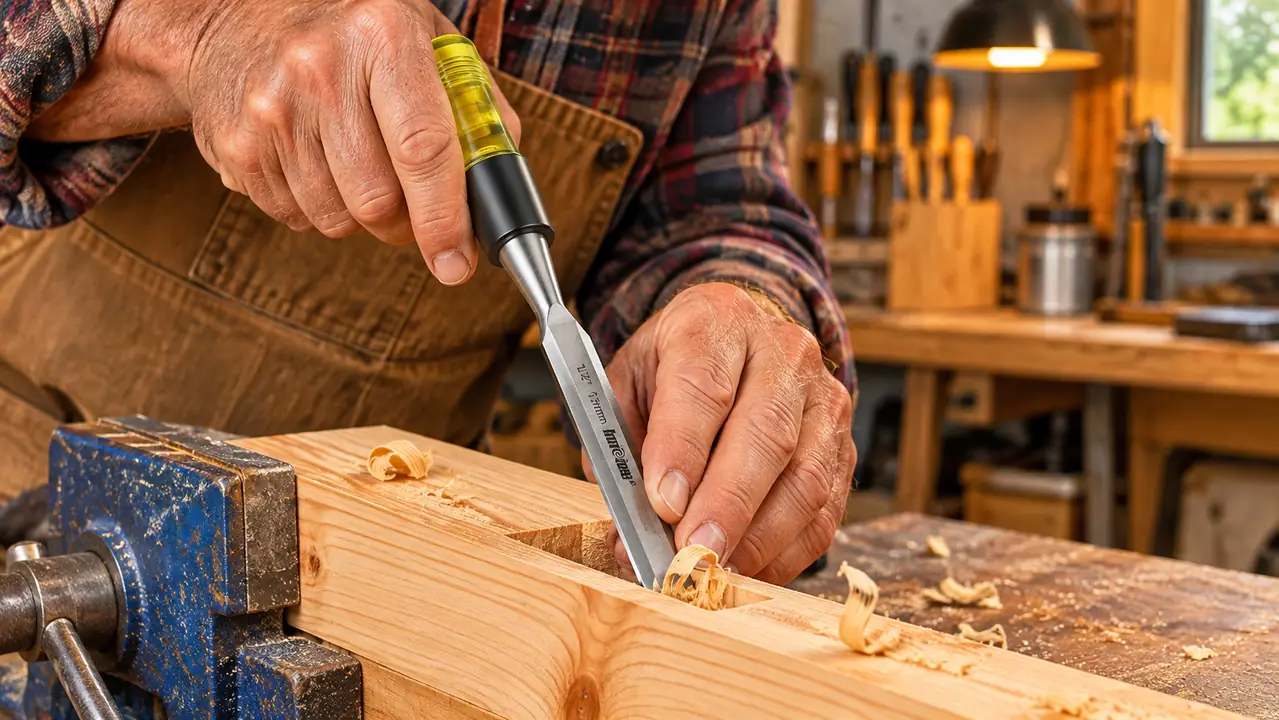
The first place it wins is the one nobody puts in a review: willingness to be handled. A garage shop is a hostile place for a sharp edge. Chisels get set down on a bench with sawdust on it, knocked against a shop vac hose, and used by a twelve year old grandson who is learning to pare the roof of a birdhouse. The HURRICANE set has blade guards that go on and stay on, and a case that closes. When Tyler is in the shop on a Saturday, the chisel he gets handed is one of these four.
The second is the handle. PVC is not pretty and it does not feel like a traditional tool, but it wipes clean, it does not soak up oil or finish, and it survives being dropped on a concrete floor. In a shop where the humidity swings with the weather and there is a wood stove going in January, a handle that does not move is worth something. The regular grip is comfortable in my hands, and my hands are not small.
The third is cost of entry. A four piece set that covers 1/4 through 1 inch, with a case and blade guards, means a new woodworker can put the rest of the tool budget into a sharpening stone and a honing guide. Those two items matter more to your results than the name stamped on the blade. Buying an expensive set and sharpening it on sandpaper on a pane of glass is a worse start than buying this set and learning to sharpen properly.
Where Narex Wins
The back of the blade. A chisel only cuts as true as its back is flat, and the first job with any new chisel is lapping the back until it registers on the stone. The Narex set needed less of that work. Not none, but noticeably less. Across four chisels that is an hour of your life back, and an hour of lapping on a coarse stone is an hour your forearms remember the next morning.
The second is edge holding in hardwoods. In pine and poplar, honestly, I cannot tell the two sets apart. In white oak and hard maple the Narex chisels hold a paring edge longer before they start to skate, which means fewer trips to the stone in the middle of a joint. If you build with domestically grown hardwoods, that is the whole argument in one sentence.
The third is feel. The stained beech handle and brass ferrule put the balance point where it sits better in the hand during long paring work. That is the least measurable difference and the most real one. After an hour of cleaning up dovetails, my hand knows which chisel it is holding.
In pine I cannot tell the two sets apart. In white oak, the Narex chisels keep paring while the budget set starts to skate.
Four sizes, blade guards, and a case for a first bench
This is the set I hand to a beginner and the set that rides in the truck for repair jobs. It covers 1/4, 1/2, 3/4 and 1 inch, it protects its own edges, and it will not make you baby it.
Amazon Check Today's Price on Amazon →The Steel, the Bevel, and What It Means at the Bench
Both sets are chrome vanadium steel ground to a 25 degree bevel. That is standard bench chisel geometry and it is the right geometry for general work. The HURRICANE blades are drop forged with heat treated edges, and those edges have held up to everything I have asked of them in pine, poplar and cherry. I have not driven one through a nail with a steel hammer and I do not plan to test that.
Where the geometry matters is what you can do with it. A 25 degree bevel is right for paring and for light chopping. These are bench chisels, not mortise chisels with heavy hoops built for a steel hammer, so use a wooden or plastic mallet, let the edge do the work, and do not pry with a quarter inch blade. I learned that one the expensive way years ago on a different set, and I still have the bent chisel hanging on the wall to remind me.
The four sizes are also the right four for a small shop. A 1/4 inch for cleaning out corners and hinge gain, a 1/2 inch which is the one I reach for most, a 3/4 inch for wider paring, and a 1 inch for cleaning tenons and trimming end grain. You will eventually want a 1/8 inch for small work and something wider for door work. Neither set fills those gaps and neither is supposed to.

Handles, Fit, and Living With Them in a Small Shop
My shop is a converted one car garage, roughly twelve by twenty feet, with a wood stove in the corner and a shop vac plus a portable dust collector I drag around. There is no room for a chisel roll lying open on the wall and no room for a second bench. Tools live in cases or on a rack, and they get put away at the end of a session because the same bench becomes an assembly table twenty minutes later.
That argues for the HURRICANE case and against loose chisels rattling in a drawer. The Narex set arrived in a cardboard box, so I built a simple rack for it out of a scrap of maple and it hangs above the bench where I can see it. If you have the wall space, a rack is the better arrangement for any chisel you use daily. If you do not, a case that closes is not a small thing.
Sharpening Is Where the Difference Shows Up
Neither set arrives ready to pare end grain. The budget chisels need more work on the back, and that is the honest trade you are making. My routine is a coarse diamond plate for the back when it needs it, a 1000 grit water stone, a 6000 grit stone, and a honing guide for the primary bevel. Thirty seconds on the fine stone at the end of a session keeps an edge alive far longer than an hour of grinding once a month.
The practical difference between the sets is how often you stop work. With the HURRICANE chisels in pine and poplar I touch up once at the start of a session. With the Narex chisels in white oak I get through a full set of mortises before I need the stone. That is the return on the extra money, and it is a return you only collect if you actually sharpen. A dull expensive chisel is worse than a sharp cheap one every single time.
What Neither Set Will Fix
Two things. The first is technique. A sharp chisel in an unsteady hand will still gap a dovetail, and no steel on the market corrects that. The second is a dished water stone. If your stone is hollow in the middle, every chisel you sharpen on it gets sharpened to the shape of the hollow, and you will chase that problem for months without understanding why. Flatten the stone, then sharpen the chisel.
I would also say this about buying hand tools generally. The gap between a budget bench chisel and a mid range one is real, but it is not the gap between unusable and excellent. The gap between either of them and a dull chisel is enormous. Spend accordingly, and spend on sharpening first.
Who Should Buy Which
Buy the HURRICANE set if you are new to hand tools, if you are outfitting a bench on a hobbyist budget, if the shop is shared with a kid or a neighbor, or if you want a second set to keep in the house for repair jobs. It covers the four sizes that do most of the work, it protects its own edges, and it will not make you baby it. Given what a sharpening stone and a honing guide cost, starting here and learning to sharpen is the smarter order of operations.
Buy the Narex set if you already own chisels, you build furniture from hardwoods, and you have noticed that your current chisels need attention in the middle of a joint. You are paying for flatter backs, longer edge life and a handle that feels right in the hand. If you are not sharpening on a regular schedule, that money is wasted, and I would rather you put it toward a good stone.
And if you land somewhere in the middle, there is no rule against owning both. The budget set does the rough work and the borrowing. The better set stays sharp for the cuts that show.
Start with the set you can afford to sharpen
A budget chisel you learn to sharpen will cut better than an expensive one sitting dull in a drawer. If there is still an empty slot in the rack over your bench, the HURRICANE set is where I would start.
Amazon See the HURRICANE set on Amazon →