
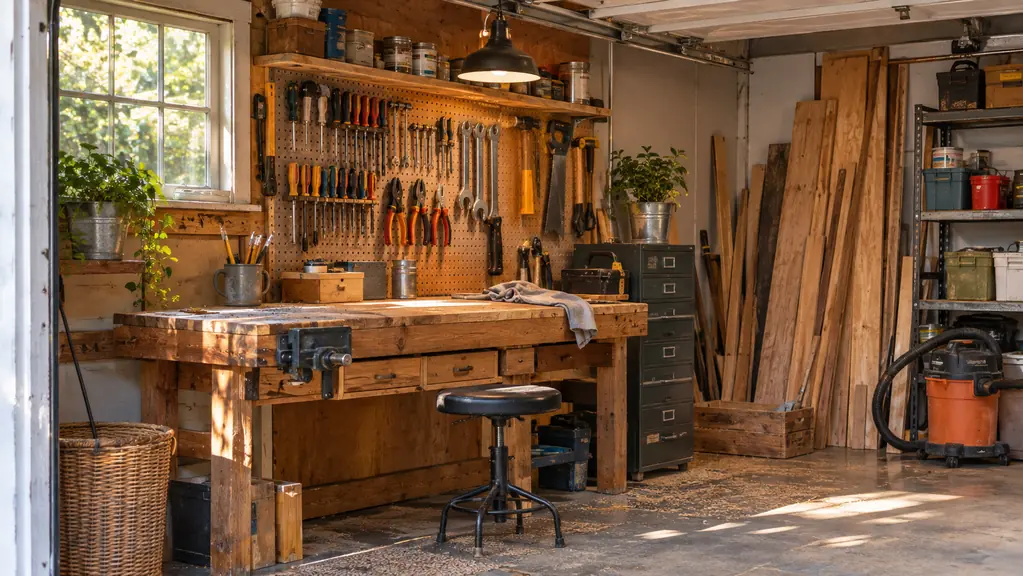
Twelve feet by twenty. That is my shop, a converted one-car garage outside Philadelphia with a wood stove in the corner and a shop vac parked where a car used to go. Every tool in there has to justify the square footage it eats. When I bought the Bosch PR20EVS Colt palm router, I expected a convenience tool. It turned out to be the router I reach for most often, and the reason is almost entirely about size.
A full-size router needs a table or a wide base plate and room to swing a workpiece past it. A palm router weighs 3.3 pounds and fits in one hand. In a shop like mine that difference is not a luxury, it is the thing that decides whether a tool gets used or stays in its case under the bench. Here are ten reasons it earns its footprint, in the order I noticed them.
The router that earns its shelf space
3.3 pounds, 1.0 HP, variable speed from 16,000 to 35,000 RPM, and a fixed base that takes bits up to 1-5/16 inch. Small enough to live on a shelf, capable enough to do real trim work.
Amazon Check Today's Price on Amazon →It earns shelf space, not floor space
The router weighs 3.3 pounds and measures 3.75 inches wide by 7.5 inches tall. That is small enough to sit on the shelf above my bench next to the block plane. My table saw and my benchtop jointer both need floor space and both have to be rolled out before they can be used. The Bosch comes off the shelf, gets used, and goes back. In a shop this size, that decides whether a tool gets used at all.
One hand runs the tool, the other steadies the work
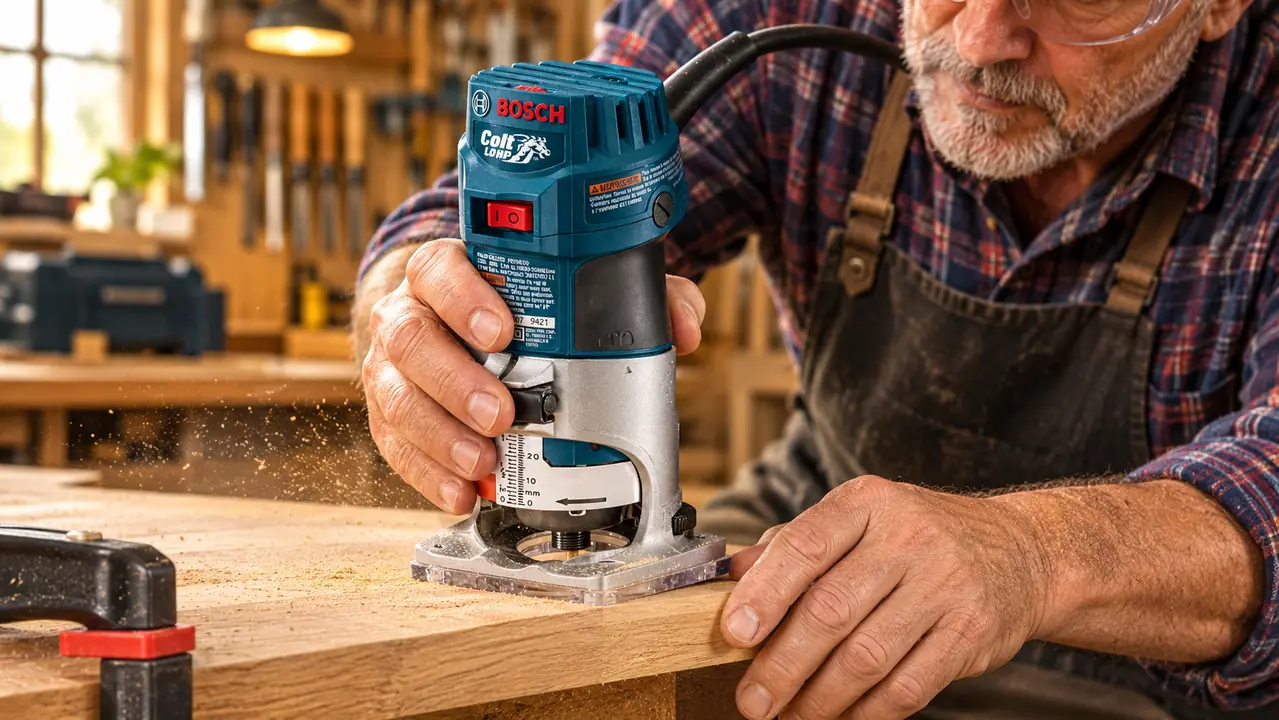
A full-size router wants two hands and a wide stance. The Colt is a one-hand tool, which matters when you are trimming edge banding on a bookcase that is already assembled and far too big to put on a table. I have trimmed oak banding on a finished shelf with my left hand holding the case steady and my right hand walking the router along the edge. Nothing else in my shop does that job.
The speed range covers small bits and wide bits
The motor runs from 16,000 to 35,000 RPM and it is variable, so you match speed to the bit. Small straight bits and roundovers want the upper end. Anything with a wide cutting circle needs to run slower or it burns. I turn it down for a chamfer bit, up for a 1/8 inch roundover, and I stop thinking about it. Getting the speed wrong is how beginners scorch edges and dull good carbide.
The fixed base swallows a 1-5/16 inch bit
The Bosch base opening takes bits up to 1-5/16 inch in diameter, which is more than you expect from a trim router. A chamfer bit, a roundover, a small cove, and a 3/4 inch straight bit all fit without swapping anything. I keep a 1/2 inch straight bit in mine for hinge mortises and it clears fine. On a shop with one router, that flexibility is most of the value.
The edge guide reaches 3-5/8 inches in from the edge
The straight edge guide runs along the edge of a workpiece and adjusts out to 3-5/8 inches. That covers most of what I do: decorative grooves in a blanket chest side, a stopped dado for a bookshelf, a shallow rabbet on the back of a cabinet. It is not a router table with a fence and it does not pretend to be. For one-off cuts it is faster than setting up anything else.
Bit changes take seconds instead of minutes
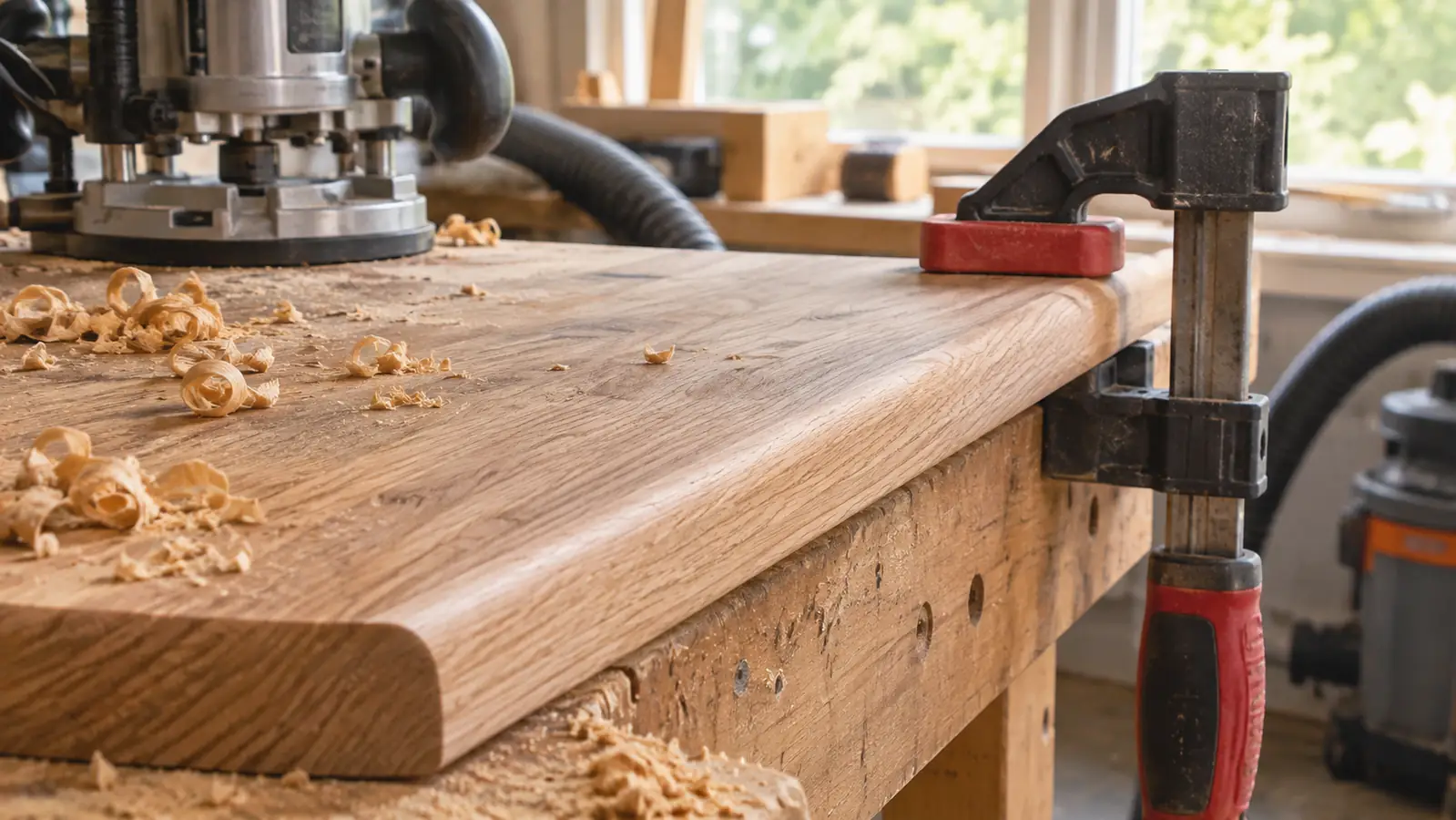
The 1/4 inch self-releasing collet chuck lets go of the bit when you loosen it, so you are not prying a stuck bit out with a screwdriver and a bad attitude. That sounds minor until you have done it forty times in an afternoon. I change bits far more often than I change tools, and a collet that releases cleanly is the difference between a smooth rhythm and a fight.
The Quick-Clamp system takes the motor out of the base
The motor releases from the fixed base in one motion instead of a wrench hunt. I use that for setting depth: bring the bit down to the work, lock it, then adjust. It also means the base can stay set up on the bench while the motor goes back on the shelf. When every square inch is contested, being able to break a tool into two small pieces is a real advantage.
1.0 HP and 5.6 amps handle 3/4 inch stock honestly
This is a 1.0 HP, 5.6 amp motor. It cuts 3/4 inch oak and maple at a sensible feed rate and it tells you when you are pushing too hard. It is not a 3 HP production machine and I do not pretend otherwise. Heavy panel raising belongs on a bigger router or in several light passes. Treated as a trim and light-duty router, mine has never let me down.
It runs off the same 120 volt circuit as the shop vac
The router is corded, 120 volts, drawing 5.6 amps. My garage has two circuits and neither one is special. I can run the router and a shop vac together without tripping a breaker, which is more than I can say for the table saw on a cold morning. No rewiring, no dedicated line, no calls to anybody, and I say that as a retired union electrician.
It is the least intimidating way to learn routing
A palm router is small enough to hold and controllable enough that a beginner can learn feed direction, depth of cut, and climb cutting without ruining a board. I taught my grandson Tyler to run an edge roundover on a birdhouse with this tool, at twelve, safety glasses on, my hands over his. A full-size router in a beginner's hands is a bad afternoon waiting to happen.
What I'd Skip
Two things. First, do not buy a pile of bits before you have used the tool for a month. A 1/4 inch straight bit, a roundover, and a chamfer cover most of what this router does well, and a thirty piece set means twenty-six bits you will never chuck. Second, skip the idea that it replaces a router table. Plunge cuts, raised panels, and long repeatable profiles still want a table and a fence or a bigger machine. I bought mine expecting a trim tool and got a shop workhorse, but I did not get a shaper. If you need to run forty feet of baseboard, this is not that tool.
3.3 pounds, 1.0 HP, variable speed from 16,000 to 35,000 RPM, and a base that takes a 1-5/16 inch bit. Those are the numbers that keep it on my shelf instead of in a case under the bench.
If your shop is twelve by twenty, this is the router that actually gets used
Fixed base, 1/4 inch self-releasing collet, straight edge guide out to 3-5/8 inches, and a limited one year warranty. It will not replace a router table. It will be the tool you reach for first.
Amazon Check Today's Price on Amazon →