
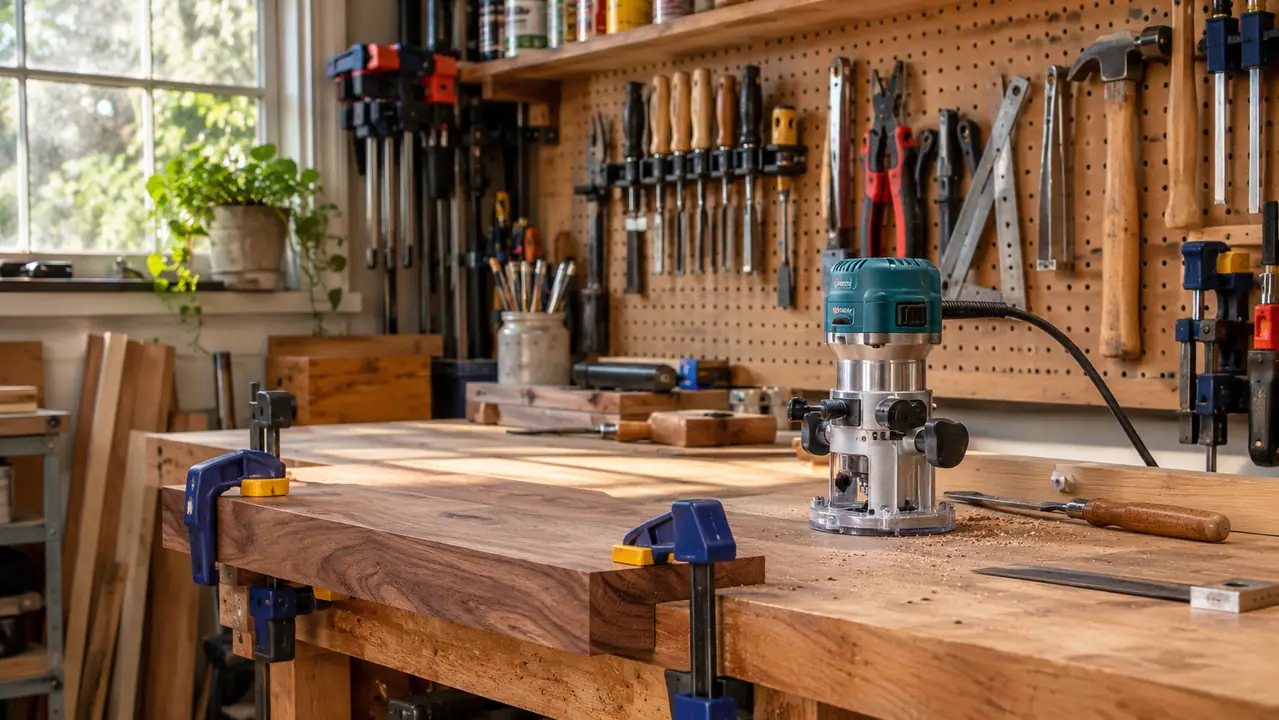
A cherry box blank sat on my bench for three weeks, squared and sanded and waiting on a roundover I kept putting off. My shop is a one-car garage, 12 by 20 feet, and the router table lives against the back wall. Dragging a piece that small across a big table and past a fence is how you lose a corner and a thumbnail in the same minute. So the box sat. I bought the Bosch PR20EVS Colt palm router for a different reason, or that is what I told Carol, but the truth is I wanted something small enough to keep on the bench instead of behind a stack of clamps.
The Colt is a corded trim router, 120 volts, 1.0 horsepower and 5.6 amps. The motor is variable speed, from 16,000 to 35,000 RPM. It weighs 3.3 pounds and stands about 7-1/2 inches tall. The base is the PR001 fixed base, made of plastic, and it takes a 1/4 inch self-releasing collet chuck. Bosch includes a straight edge guide that will hold a line up to 3-5/8 inches off the edge of a workpiece, and the fixed base swallows bits up to 1 5/16 inch. That is the whole tool. Nothing on that list is exciting, and every item on it is why the router is still sitting on my bench.
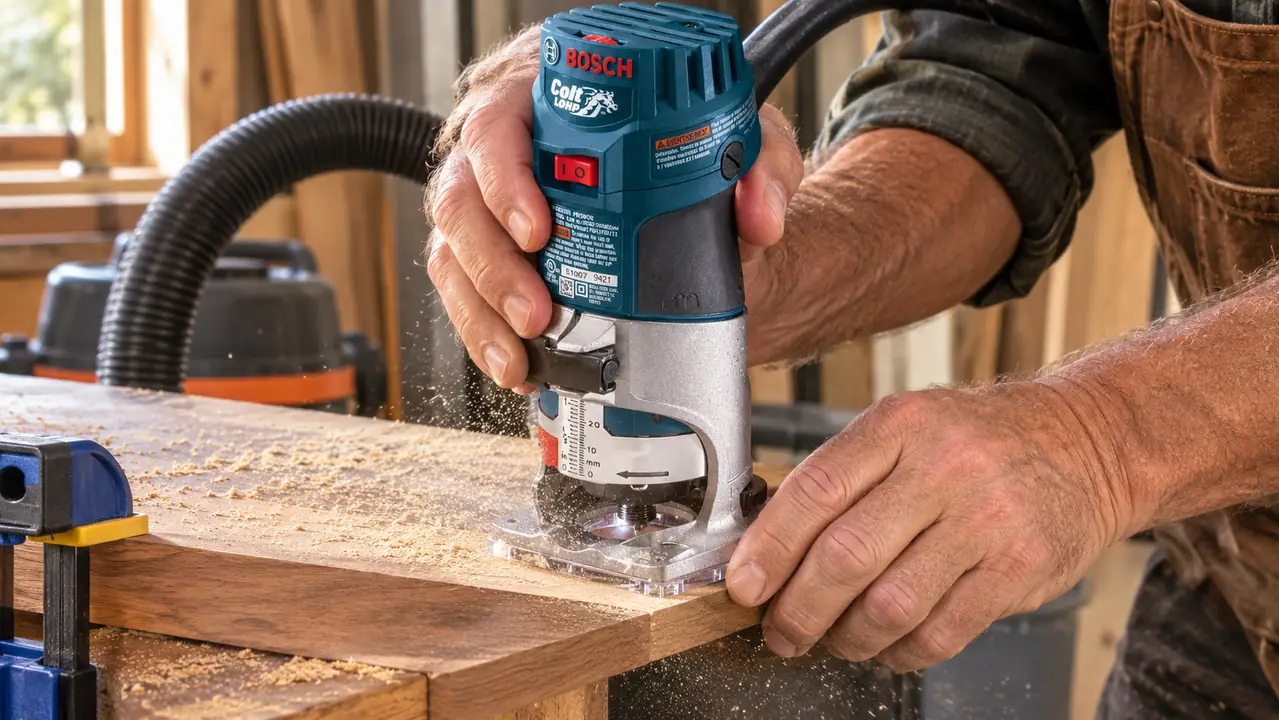
The first job was not the box. It was a batch of birdhouses for Tyler, my grandson, who is 12 and believes anything with a roof is a gift. I clamped each body to the bench, set the depth, and ran a small chamfer along the roof line. A palm router is led with two hands and a lot of attention, and the small base means you feel the cut through your wrists. By the fourth birdhouse I had stopped thinking about where my hands were, which is exactly when a man should stop and slow down.
On the fifth one I got careless. I had the speed turned up, took a full pass on a scrap of cherry, and burned the edge. Cherry scorches fast, and a dull bit at high RPM will do it in one pass. I backed the speed down, took two lighter passes, and the edge came out clean. That is not a flaw in the router. It is a flaw in the operator, and variable speed is what let me fix it without buying anything.
What the Colt will not do is replace a router table. It comes with one fixed base, no plunge base in the box, and a 1/4 inch collet that will not hold the big raised panel bits I run on the table. It carries a limited one year warranty, which is not generous for a tool that gets used hard. If you need to swing a heavy bit through oak all afternoon, this is the wrong router, and you already know that.
A dull bit at high speed burned a cherry edge in one pass. The fix was not a new tool. It was slowing down and taking two lighter cuts.
The router that lives on the bench, not behind the clamps
The Bosch PR20EVS Colt is a 1.0 HP trim router, 3.3 pounds, variable speed from 16,000 to 35,000 RPM, with a fixed base that takes bits up to 1 5/16 inch. It is the one I reach for on anything I cannot safely carry to the table.
Amazon Check Today's Price on Amazon →Chip clearance on a small router is not great, and I will not pretend it is. I keep the shop vac hose near the cut and stop every few feet to clear the edge, because a packed base will wander off the line. The portable dust collector handles what gets airborne. Neither one is perfect. That is a shop problem more than a tool problem, but you should hear it before you buy.
Bit changes are quick because of the self-releasing collet. Crack the chuck loose and the bit comes out instead of staying stuck in a hot collet, which saves a fair amount of cursing. I keep two bits out on the bench, a small roundover and a chamfer, and between them they cover most of what a hobby shop asks of a tool like this.
The straight edge guide gets used more than I expected. Setting it 3-5/8 inches off the edge of a panel and running a groove for a bookshelf back used to mean dragging out the table and a featherboard. Now it means clamping a straightedge and paying attention for six minutes.
Tyler asks to run it every time he is over. The answer is no for now. He holds the shop vac and he watches, and when he is taller and has safety glasses that fit him, we will talk about it. A 3.3 pound router does not sound heavy until it kicks.
The cherry box got its roundover on a Tuesday morning before the shop warmed up. Two passes, one edge at a time, and the corners came out even. It sits on the shelf in the front room now. That is a small thing to hang a tool purchase on, but it is the honest reason the router stayed.
What I'd Tell You If We Were Sitting at My Kitchen Table
I would tell you that a palm router is not a small router table and it is not meant to be. It is for edges, chamfers, roundovers, hinge recesses and shallow grooves on pieces too small or too awkward to carry to the table. In a garage shop, that is most of what I actually build. If you are hanging raised panel doors every weekend, save up and buy something with more motor and a plunge base, because this one will frustrate you. And buy good bits. A cheap bit in a good router burns cherry just as fast as a cheap router does.
If your bench is the only clear surface in the shop
The Bosch PR20EVS Colt comes with the PR001 fixed base, a 1/4 inch self-releasing collet chuck and a straight edge guide. It is rated 4.6 stars across more than 3,500 reviews. If space is the thing you are short on, this is the router that fits.
Amazon Check Today's Price on Amazon →