

My shop is a one-car garage, about 12 by 20 feet, and once the table saw, the workbench, the wood stove, the shop vac and the portable dust collector are in place there is not a lot of floor left to stand on. In February the snow shovel lives in there too, leaning against the wall by the door, which tells you how much room I am actually working with. That is the whole reason I went looking for a palm router in the first place. I wanted to break the edges on a cutting board, cut a shallow groove for a drawer bottom, and chamfer a table leg without dragging out a full-size router and the fence setup that goes with it. The Bosch Colt PR20EVS ended up being the tool that does that work, and it has lived on the shelf above the bench ever since.
I owned a cheap trim router before this one, and it taught me the difference between a tool and a toy. The base crept, the depth setting drifted between passes, and the motor bogged down the first time I put it into white oak. I spent more time re-setting depth than routing, and after one long Saturday on a bookshelf I put it in a box and stopped reaching for it. What sold me on the Bosch was not a feature list. It was the 3.3 pounds and the fact that I could hold it in one hand at the far end of a board and still steer it. In a shop this small, a tool I can pick up, use and put back in under a minute gets used. A tool that needs a setup ritual does not.
The Quick Verdict
Light enough to steer one-handed, fast enough for edge work in hardwood, and small enough to live on a shelf in a one-car garage. The fixed base and the 1/4 inch collet are the real limits, not the motor.
Amazon Check Today's Price →The trim router that earns its footprint instead of taking one
1.0 HP, 5.6 amps, variable speed from 16,000 to 35,000 RPM, and 3.3 pounds you can steer with one hand. See today's price on the Bosch Colt PR20EVS.
Amazon Check Today's Price on Amazon →How I've Used It
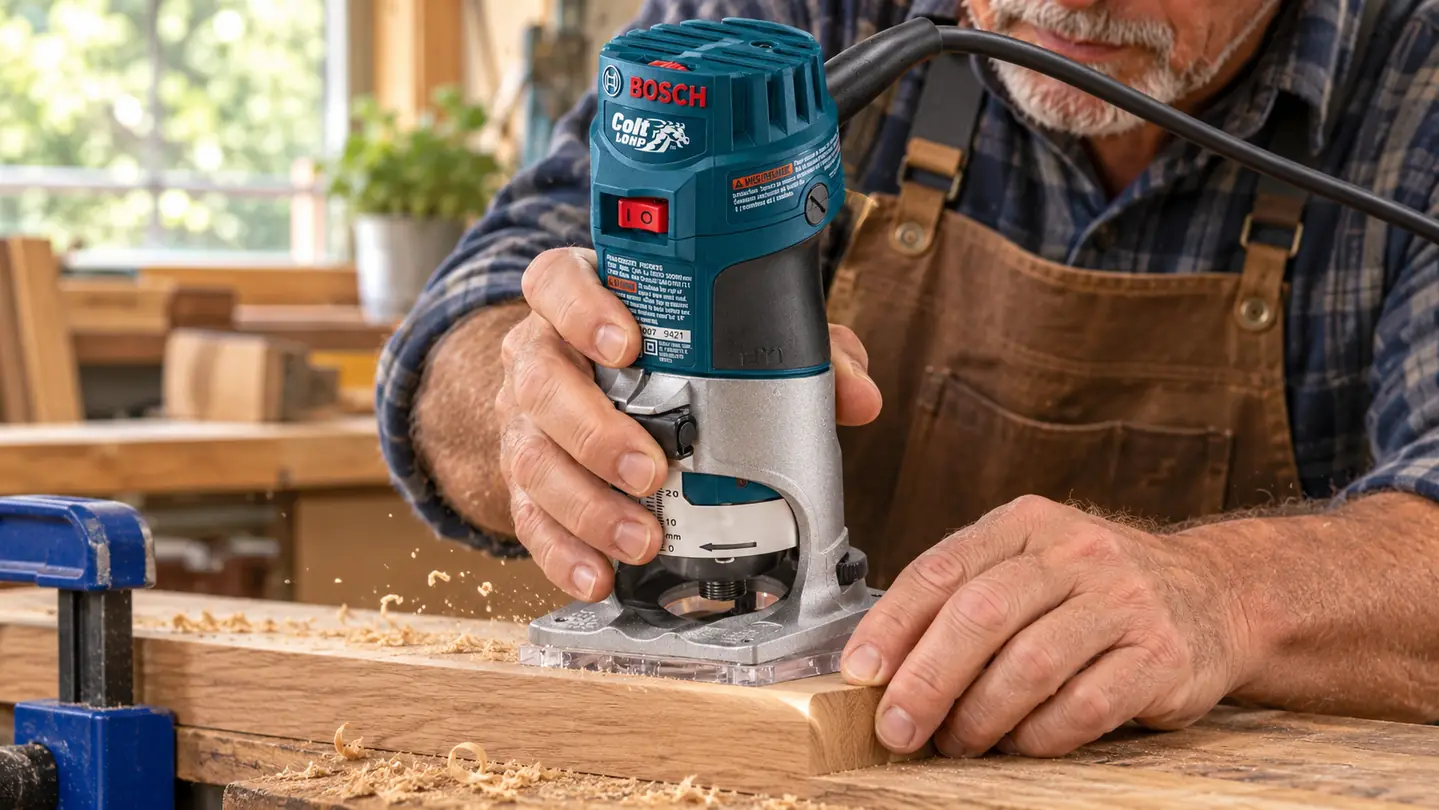
Most of what I build is small furniture and gifts. Cutting boards, end tables, bookshelves, an occasional cherry blanket chest, birdhouses, and toys for my grandson Tyler, who is twelve and helps on weekends with safety glasses on and a firm reminder about where his hands go. That kind of work is a lot of edge profiles and a lot of shallow joinery, and almost none of it is big enough to justify setting up a router table. The Colt handles it. I clamp the piece to the bench, set the depth, and go. The last batch was six maple cutting boards for a neighbor whose daughter was getting married in October. I broke all four edges on all six boards, plus a chamfer on the end grain, in under an hour including the time it took to sweep up.
On cutting boards I run a 1/4 inch roundover on all four edges and then a light chamfer on the end grain so the corners do not catch the heel of your hand when you pick one up. On the end tables I cut a 1/4 inch groove for a plywood drawer bottom and a rabbet for the back panel. The 1.0 HP motor does not complain about any of it, and I am not fighting the tool to keep it flat against the work. The maple was not forgiving, and I took two light passes instead of one heavy one. That is a habit this router taught me.
The place I noticed the difference was harder stock. Tyler and I built a small white oak step stool last year, and the Colt pulled a chamfer along the stringers without the motor loading up and changing pitch halfway down the cut. That is a thing you cannot read off a spec sheet. A router that bogs down makes you push, and pushing is how you end up with a burn mark, or worse, a climb cut that grabs. A router that holds its speed lets you feed at the rate the cutter wants. Tyler held the vac hose and counted the passes out loud, which is his job now, and the cut came out cleaner than the one I did on the old router with him watching.
What the Variable Speed Control Does for Real Work
The motor is 5.6 amps and the speed range runs from 16,000 to 35,000 RPM. For most edge work in wood I am somewhere in the middle of that. Where the low end earns its keep is with larger diameter bits. A wide roundover or a panel bit running flat out in hardwood is asking for a scorched edge, and turning the speed down lets the cutter take a bite instead of rubbing. I learned that on a piece of cherry I had already spent two evenings on. A 3/4 inch roundover at full speed left a brown burn along forty inches of edge, and I had to plane it off and start over.
It takes maybe ten minutes on scrap to learn where your bits like to run, and after that you stop thinking about it. That is the highest compliment I can pay a control. It becomes muscle memory. I keep a short piece of pine and a piece of hard maple near the bench for exactly this, and when I change to a bit I have not used in a while I make one pass on each before I touch the actual workpiece. Two scrap passes have saved me more than one finished part.
One caution, because I learned it the hard way. Variable speed means you can slow the tool down, not that you should slow it down for everything. Run a small straight bit too slow in cherry and you will see the marks in raking light. Set the speed for the bit diameter, not for how nervous you are feeling that morning. My rule now is simple. Small bit, high speed. Big bit, slow down. When I am unsure, the scrap pile gets a vote.
The Quick-Clamp Base, Bit Changes, and the 1/4 Inch Collet
The base is fixed, and it attaches to the motor with a quick-clamp system. That means I can pull the motor out of the base, set the depth on the bench where I can actually see it, and clamp it back in without hunting for a wrench. In a hobby shop this matters more than it sounds. One motor can serve more than one setup, and I am not buying a second router just to get a second base. The fixed base in the box is the PR001, and it is the only base I have used, so I cannot tell you how the others feel.
Bit changes go through a 1/4 inch self-releasing collet chuck. When you loosen it the collet lets go of the bit instead of holding on while you pry at it with your other hand. It saves a few seconds on every change and a few scraped knuckles a year, and after enough changes you notice both. The base accepts bits up to 1-5/16 inch in diameter, which covers every bit I own for this tool. I checked that number against my bit drawer when the router arrived, and my widest roundover sits comfortably under it.
The base diameter is 1.56 inches, and that number is the one that decides how close you can get into a corner. A small base means a small footprint, which is what you want on the inside of a picture frame or the shoulder of a small box. It also means less of the base is supported on a narrow workpiece, so on anything under a couple of inches wide I clamp a backer board underneath to widen the surface. On a birdhouse gable last spring the whole cut was inside a shape not much bigger than my hand, and the small base was the reason it worked.
The Edge Guide and the Jobs It Handles
The router comes with a straight edge guide, and it lets you follow the edge of the workpiece or run a cut up to 3-5/8 inch in from the edge. I use it for grooves in bookshelf sides and for shallow dados where I do not want to measure and clamp a straightedge across the bench. It is not a substitute for a router table and a fence, but for one groove in one shelf side it is faster than setting up anything else, and in this shop the fastest setup is the one that actually gets done. The last bookshelf got four grooves. Measuring and clamping a straightedge four times would have taken longer than the routing did.
The other thing 3.3 pounds does is make one-handed control realistic. Holding the tool against a guide with one hand and feeding the work with the other is comfortable at that weight. Anything heavier and I want both hands on the tool, which means I need a different way to hold the work, which means a jig, which means setup time. The entire advantage of a palm router in a 12 by 20 foot shop is that it collapses that chain. My old router weighed enough that I never once used it one-handed, and I did not realize how much that slowed me down until I stopped doing it.
I have also used it to trim the edge banding on a neighbor's countertop repair and to cut hinge gains on a small cabinet door. Both are jobs where a full-size router is more tool than the work needs and a chisel is more patience than I have on a Tuesday night. The Colt sits in the middle of that range, which is where most of my work lives. The hinge gains were the fussier of the two, because a sixteenth of an inch too deep shows, and the fixed base held the depth through four doors without me touching the setting.
Where It Runs Out of Grunt
The Bosch is a 1.0 HP trim router with a 1/4 inch collet, and there are jobs it will not do. Raising panels, cutting cope and stick for cabinet doors, a deep mortise in white oak, or spinning a big panel bit all want more motor and a 1/2 inch shank. You can hear it start to labor, and when a small router starts to labor the right answer is to stop and change your approach, not to push harder. I have pushed harder. I have the scorched bit to prove it. The pitch of the motor drops before the cut goes bad, and once you learn that sound you have about a second to back off.
Depth adjustment is the other place it is not a full-size router. The fixed base does what it should, but you are not going to dial in a precise depth change mid-pass the way you would with a plunge base. For most of my work the answer is to cut in two shallow passes and accept it. On the rare job that genuinely needs a plunge, I do it on the table saw with a dado stack, or I borrow my neighbor's plunge router and buy him a coffee. The two-pass habit is worth building anyway. It is easier on the bit, easier on the motor, and easier on the edge of the wood.
The warranty is one year limited, and I have not had to use it. The body is plastic, and it has picked up a few scuffs from being set down on the bench instead of back on the shelf. The collet, the base and the motor have given me no trouble at all, and the one time I thought the collet was slipping it turned out to be a bit with a worn shank. I wiped the shank, put it back in, and the problem went away. That was two years ago and it has not come back. It measures 3.75 inches wide by 7.5 inches high, which is why it fits on the shelf above the bench with room to spare.
What I Liked
- 3.3 pounds, so you can steer it one-handed at the far end of a long board
- Speed range from 16,000 to 35,000 RPM covers both big roundovers and small bits
- Quick-clamp base lets one motor serve more than one setup
- 1/4 inch self-releasing collet lets go of the bit instead of fighting you
- Small 1.56 inch base diameter gets into corners a full-size router cannot reach
Where It Falls Short
- 1/4 inch collet only, and 1.0 HP runs out of power on panel bits and deep mortises
- Fixed base only, so plunge work means a second base or a different tool
- Depth changes are fussier than on a full-size router
- Plastic body will show wear if you set it down on the bench instead of the shelf
The 1.0 HP motor pulled a chamfer along white oak stringers without loading up and changing pitch. That is the thing you cannot read off a spec sheet.
Who This Is For
This is for the home woodworker in a garage or a basement corner who needs to break edges, cut shallow grooves and rabbets, and trim edge banding without giving up floor space. It is for the person who has a table saw and a bench and a budget, and who would rather own one small router that gets used every week than a large one that gets used twice a year and needs its own cabinet. If you are working in a 12 by 20 foot shop and every tool has to earn its footprint, this one does. It is also a decent first router, because the small size makes it less intimidating to learn on than a two-hand machine.
Who Should Skip It
Skip it if you build cabinet doors, raised panels, or anything that wants a 1/2 inch shank and a plunge base. Skip it if you plan to bolt a router into a table and use it as a shaper, because a trim router in a table is a compromise you will feel on every pass. And skip it if you only ever need one job done, because a neighbor with a router and a free Saturday is cheaper than any tool on the shelf.
One small router that has outlasted three shop rearrangements
If your shop is a garage and your bench shares space with a snow shovel, this is the router that still gets picked up. Check today's price on the Bosch Colt PR20EVS.
Amazon Check Today's Price on Amazon →