
Pocket-hole joinery gets written off as the shortcut for people who have not learned real joinery yet. I believed that for a long stretch. Thirty years into woodworking, with a 12 by 20 foot garage shop and no room for a mortiser, I bought a Kreg R3 to build one end table fast and get out of the cold. That was the whole plan. It has since gone into bookshelves, face frames, a set of shop cabinets, and a cherry blanket chest.
Here is what the purists leave out. A pocket screw is not trying to be a mortise and tenon. It is a way to hold two boards together accurately enough that the project gets finished. For a hobbyist with limited space and a Saturday afternoon, that difference matters more than tradition. These are the ten reasons it keeps earning shelf space in my shop.
The jig that fits in a drawer and still holds a face frame square
The Kreg R3 measures 8 inches by 2.25 inches by 5 inches and weighs 1.3 pounds. It lives in its compact carrying case on a shelf above the bench until the next project needs it.
Amazon See the Kreg R3 on Amazon →It stores in a drawer instead of owning a corner of the shop
My garage is small and the wood stove takes a bite out of what is left. Anything needing its own cabinet has to justify the footprint. The R3 is 8 inches long, 2.25 inches wide and 5 inches tall, and it comes in a compact carrying case with the driver bit, depth collar, Allen wrench and clamp pad inside. I set it on a shelf and forget about it. Tools that hide are tools that get used, and tools that get used are the only ones I keep.
Nine depth settings cover every board thickness I actually buy
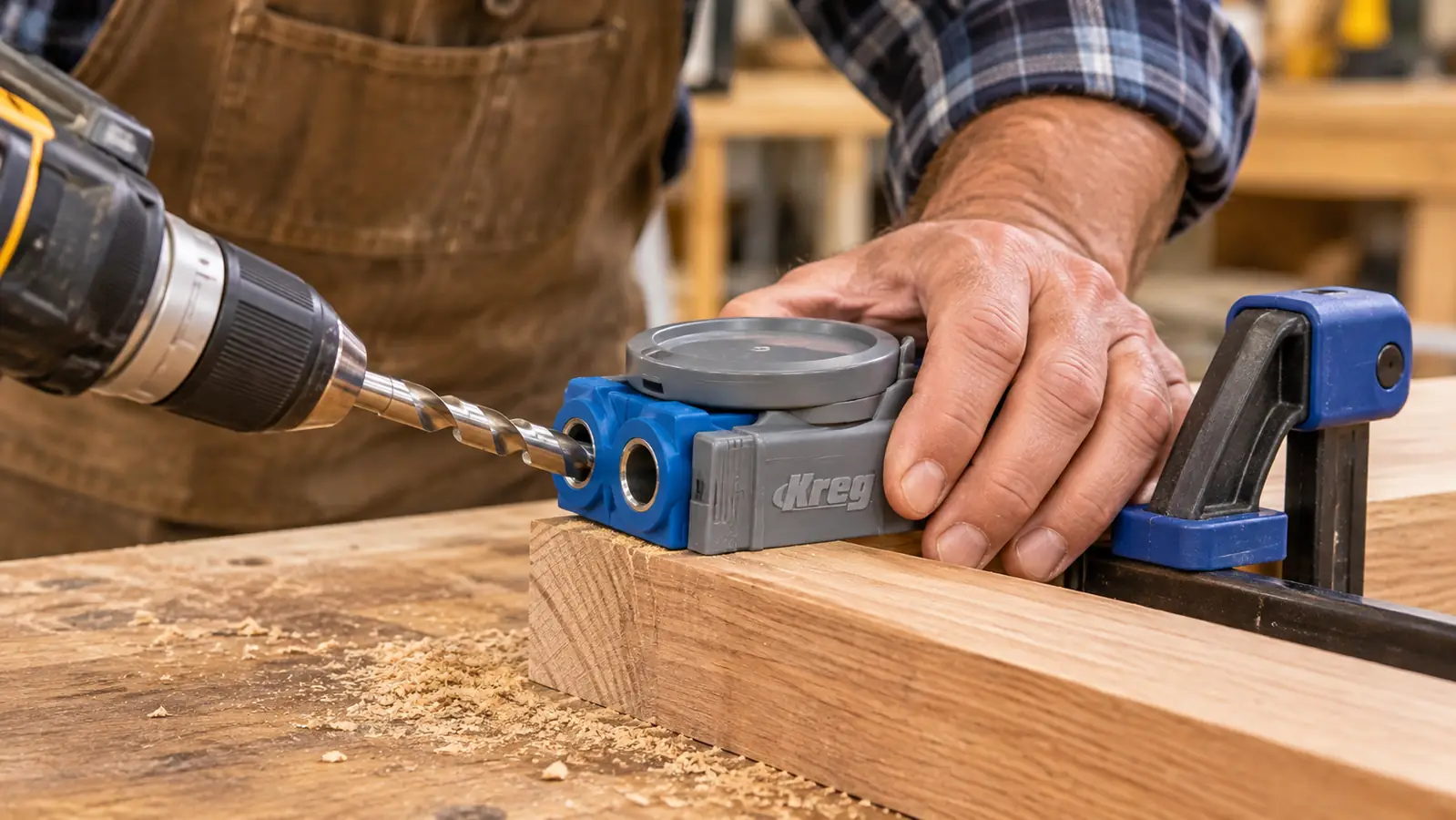
The positioning sliders have nine depth settings, and the drilling capacity goes up to 1.5 inches of material. That range runs from half-inch plywood for drawer bottoms to the thick stock I use for end table aprons. The depth collar on the bit sets screw length, and the Allen wrench in the case keeps it where I put it. No guessing, no drilling test holes in scrap every time I change stock. Set it for three-quarter inch material and it stays honest.
You are making joints the same afternoon you open the box
The first thing I built with it was a white oak end table for my daughter's living room. I had never drilled a pocket hole in my life. Fifteen minutes with the instructions and a scrap of pine, and I was running the apron rails. The learning curve is one afternoon, not one season. Compare that to your first dovetails, where the first six attempts go in the burn pile and the seventh is only acceptable if you are in a good mood.
The clamp adaptor works with the clamps already hanging on your wall
You do not have to buy a proprietary clamp to get started. The included clamp adaptor lets the drill guide work with most clamps, so my bar clamps and one old C-clamp both worked on day one. That sounds like a small thing on paper. In practice it means you are not buying an entire system before you have made a single joint. I added a face clamp later because it speeds up repetitive work, not because the jig demanded it.
Strong enough for the furniture I actually build
I am not building heirloom chairs with curved backs. I build bookshelves, end tables, shop cabinets and the occasional blanket chest. A pocket screw with glue in the joint line and the right screw length holds that work. There is a bookshelf in my basement, loaded with hardbacks, sitting on pocket-screw joints for years now without a sag or a squeak. Glue does most of the holding. The screw is the clamp that never comes off.

No mortiser, no sharpening, no relearning it every spring
A benchtop mortiser costs money and permanent bench space. Chisels cost maintenance and a skill I only touch a few times a year, which means I am always relearning them. The R3 asks for a drill and a clamp. That is the entire list. When I have an hour after supper, I want to build, not tune an edge or tram a fence. The tools that survive in my shop are the ones that do not punish me for a short session.
It forces you to decide which face is the show face first
Pocket holes are unforgiving about one thing. You have to know which side of the board will be seen before the bit goes in. That single decision, made over and over, has made me better at laying out a whole project. I mark the reference face with a pencil now out of habit, on everything, whether it gets pocket screws or not. The jig taught me that. A mistake at the drill press is loud and obvious. This one you learn quietly.
A blown hole is a twenty-minute fix, not a ruined board
I have drilled through the wrong face. Twice, and both times on expensive stock. Each time I plugged the hole with a glued dowel, let it set overnight and drilled again a half inch away. The board survived. Do that with a mortise in a cabinet stile and you are cutting a new stile. When you buy hardwood a board at a time, the ability to recover from your own error is worth real money across a year of Saturdays.
It is a joint a 12-year-old can learn with supervision
My grandson Tyler helps in the shop on weekends. Pocket holes were the first joint I taught him, because the drill guide holds the angle for him and he is not fighting the bit. He drills, I drive, and we both have safety glasses on the whole time. He built a birdhouse last spring that is still hanging on the fence. Getting a kid to a finished object in one afternoon is what keeps him asking to come back.
It gets the project finished, which is the only test that counts
There is a half-finished walnut box in my shop that I cut dovetails for. It has been half finished for years. The end tables, the bookshelves, the blanket chest and the shop cabinets all got done, and pocket screws are the reason. A joint you can execute on a Tuesday night beats a better joint you never get around to. That is not a knock on fine joinery. It is an honest note about what actually leaves the shop.
What I'd Skip
Two things I would skip. The first is buying a bigger benchtop jig on day one. If you already know you will be running cabinet after cabinet, a larger unit may eventually be worth it, but most hobbyists never get there and the R3 with its nine depth settings covers what a home shop drills. The second is pocket screws anywhere the joint will fight racking, which means chairs and anything that lives outdoors. And do not buy a screw assortment you will never open. Two lengths in the size you actually use will carry you through a year.
There is a bookshelf in my basement, loaded with hardbacks, sitting on pocket-screw joints for years now without a sag or a squeak.
One drawer-sized jig, ten reasons, one finished project
The Kreg R3 ships in a compact carrying case with a 6 inch driver bit, depth collar, Allen wrench and clamp pad. It weighs 1.3 pounds and takes less shelf space than a box of screws.
Amazon See the Kreg R3 on Amazon →