
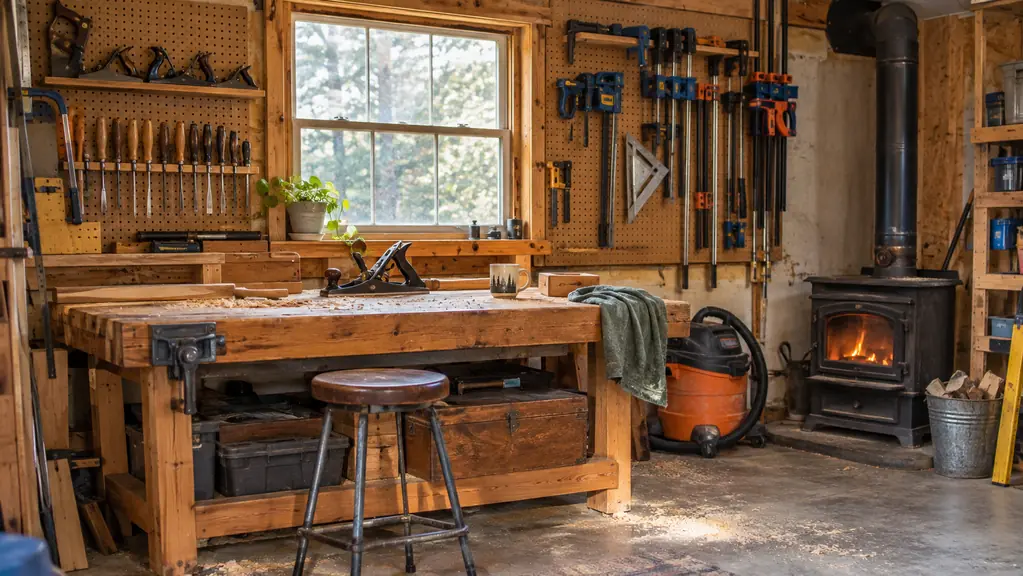
The bookshelf I built in the late nineties sagged for eleven years before I finally took it apart. The pine was fine. The joints were not. I had glued and nailed it the way my father did, and every summer the thing leaned a little further from the wall, until Carol started shelving the heavy books on the bottom row out of self defense.
I tried the other fixes first. Dowels, which I could never keep aligned with a hand drill. Biscuits, which need a plate joiner and a steady hand and give you a joint that is fine right up until someone leans on it. Dados, which need a table saw, a stacked dado set, and about four feet of clear room to the left of the blade. In a twelve by twenty garage, that last part is the whole problem. I do not have four feet to the left of anything. A retired cabinetmaker I know kept telling me to look at the Kreg jig. I nodded and did nothing for about three years.
Part of that was snobbery. Pocket holes had a reputation, in my head anyway, as a shortcut for production shops banging out face frames, or for guys building picnic tables out of pressure treated lumber. I did not think of it as joinery. I thought of it as fastening. That was a mistake and I made it for a long time before I bought the Kreg R3 and found out what it actually does.
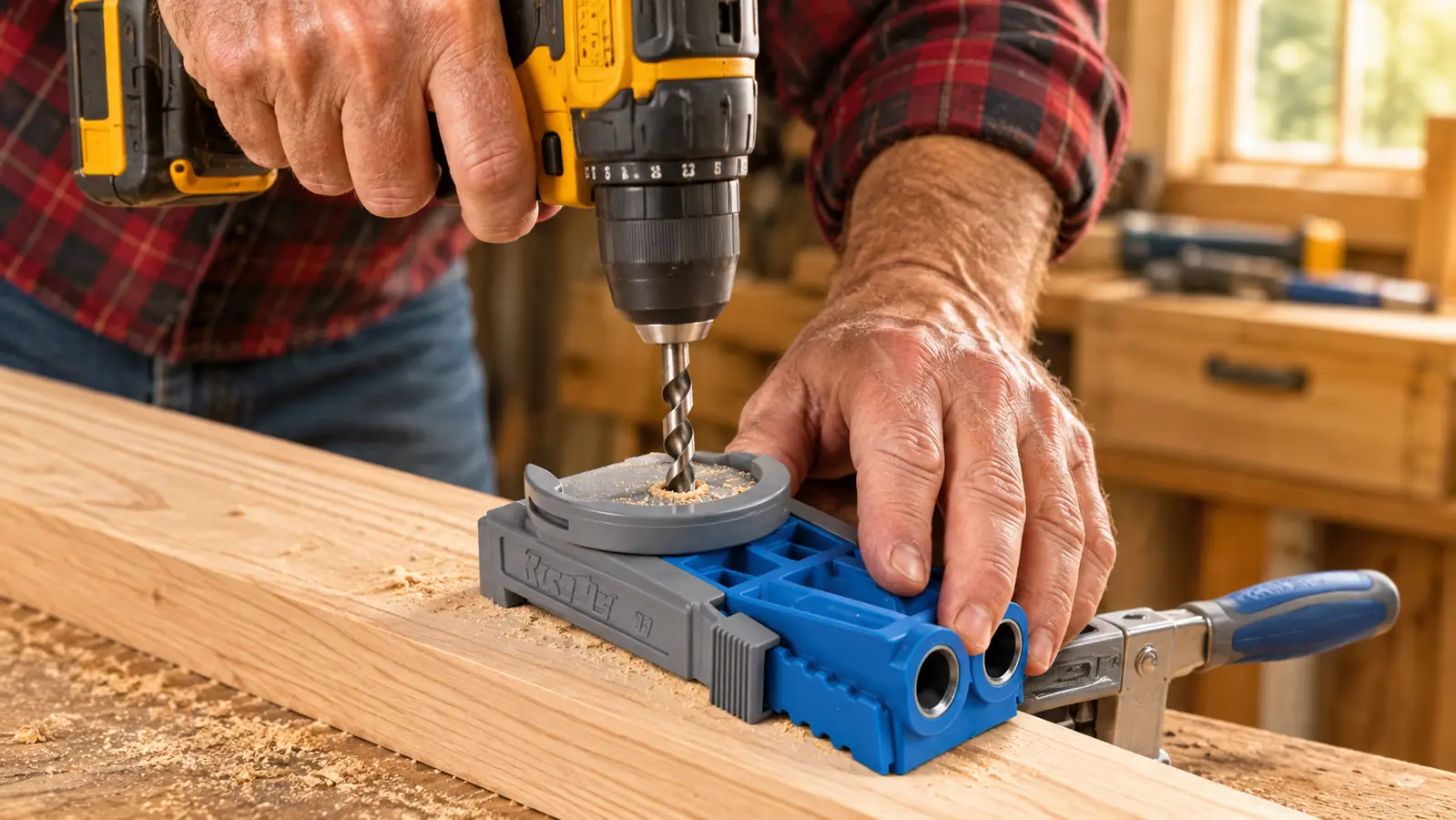
The whole system is small. Eight inches long, about two and a quarter wide, five tall, a hair over a pound. It lives in a compact carrying case on a shelf above the bench and comes down when I need it. The case holds the jig, a six inch driver bit, an Allen wrench, a depth collar and a clamp pad. There is a clamp adaptor that lets the drill guide work with most of the clamps I already own, which mattered, because I did not want to buy a proprietary clamp on top of everything else.
Setup took one evening of fumbling. You set the positioning sliders to the thickness of your stock, and there are nine depth settings, so the joint stays right whether you are joining half inch plywood or stock up to an inch and a half. The depth collar goes on the bit, you lock it with the Allen wrench, and that collar is what stops the bit from punching through the show face. Then you clamp the jig to the board and drill.
Eleven years of a sagging shelf, and the fix was a one pound jig that lives in a case above the bench.
The joint that finally held the bookshelf
The Kreg R3 is the tool I should have bought a decade before I did. Nine depth settings, a clamp adaptor that works with the clamps already in your shop, and a carrying case small enough to hang on a wall hook. Rated 4.7 from more than 9,300 buyers.
Amazon Check Today's Price on Amazon →I made the usual mistakes. I drilled through the face of a cherry apron because I switched from three quarter stock to half inch and never reset the collar. I stripped two screws learning how much pressure the driver bit wants. I clamped the jig to the wrong reference edge once and got a pair of holes pointing at each other. None of that is the jig's fault. It is the jig telling you, in the plainest way, that you skipped a step. After about twenty joints my hands stopped making those mistakes.

The rebuild of that bookshelf took an afternoon. I drilled every hole in about ninety minutes, setup included, then glued and screwed the whole thing together in one go on a flat assembly table, checking for square as I went. No waiting on one joint at a time while a clamp held the world still. When the glue cured I stood it up against the wall and pushed on the top corner. Nothing moved. It has been loaded with books for a while now and it is still square, which is more than the original managed.
It has limits and you should hear them. The drilling capacity tops out at an inch and a half of wood, so thick stock is out. It wants a drill with a half inch chuck and a battery that still has some life in it, because boring at that angle takes torque. Pocket holes are visible unless you plug them, which means the Kreg R3 belongs on inside faces and undersides, not on the front of a piece you are entering in the county fair.
What it earned is a spot. In a shop this size, a tool has to justify its footprint, and a small jig in a case on a wall hook does that without argument. I use it on bookshelves, end tables, the aprons on a small bench, and toys for my grandson Tyler. It is not the answer to every joint, but it is the answer to more of them than I expected, and I say that as a man who spent three years pretending otherwise.
What I'd Tell You If We Were Sitting at My Kitchen Table
If you are working out of a small shop and your joints are the weak part of your furniture, buy the jig before you buy another power tool. It is not exciting. There is nothing to plug in. But it removes the reason most hobby woodworkers give for nailing things together, which is that the good joints take room they do not have. Practice on scrap first. Reset the depth collar every single time you change stock thickness, even if you are only changing it for one part. Drill a test hole in a cutoff before you touch a finished piece. That is the whole method, and it costs you ten minutes. Carol still has that bookshelf. It has moved twice and it has never needed a shim.
One test hole in a cutoff saves you a finished part
Start with scrap, set the collar by the material thickness, and drill one hole you can throw away. The Kreg R3 comes with the driver bit, depth collar, Allen wrench and case so you are not hunting for pieces.
Amazon See It on Amazon →