
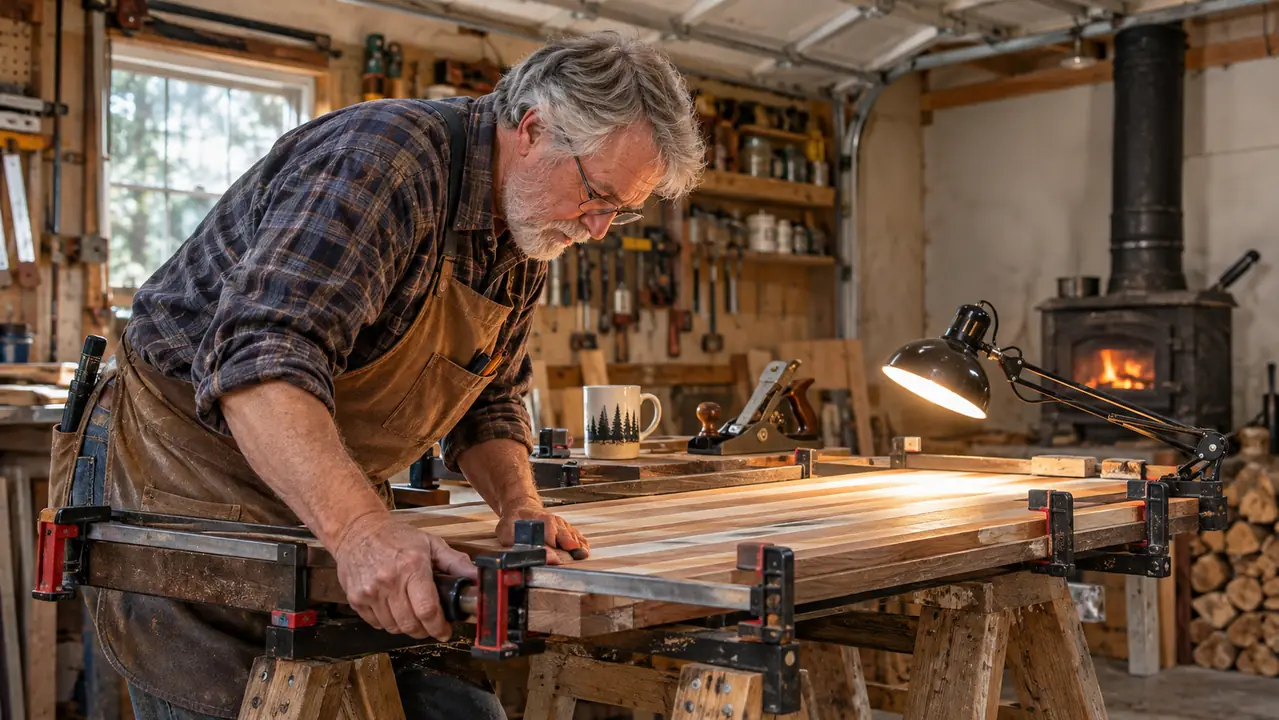
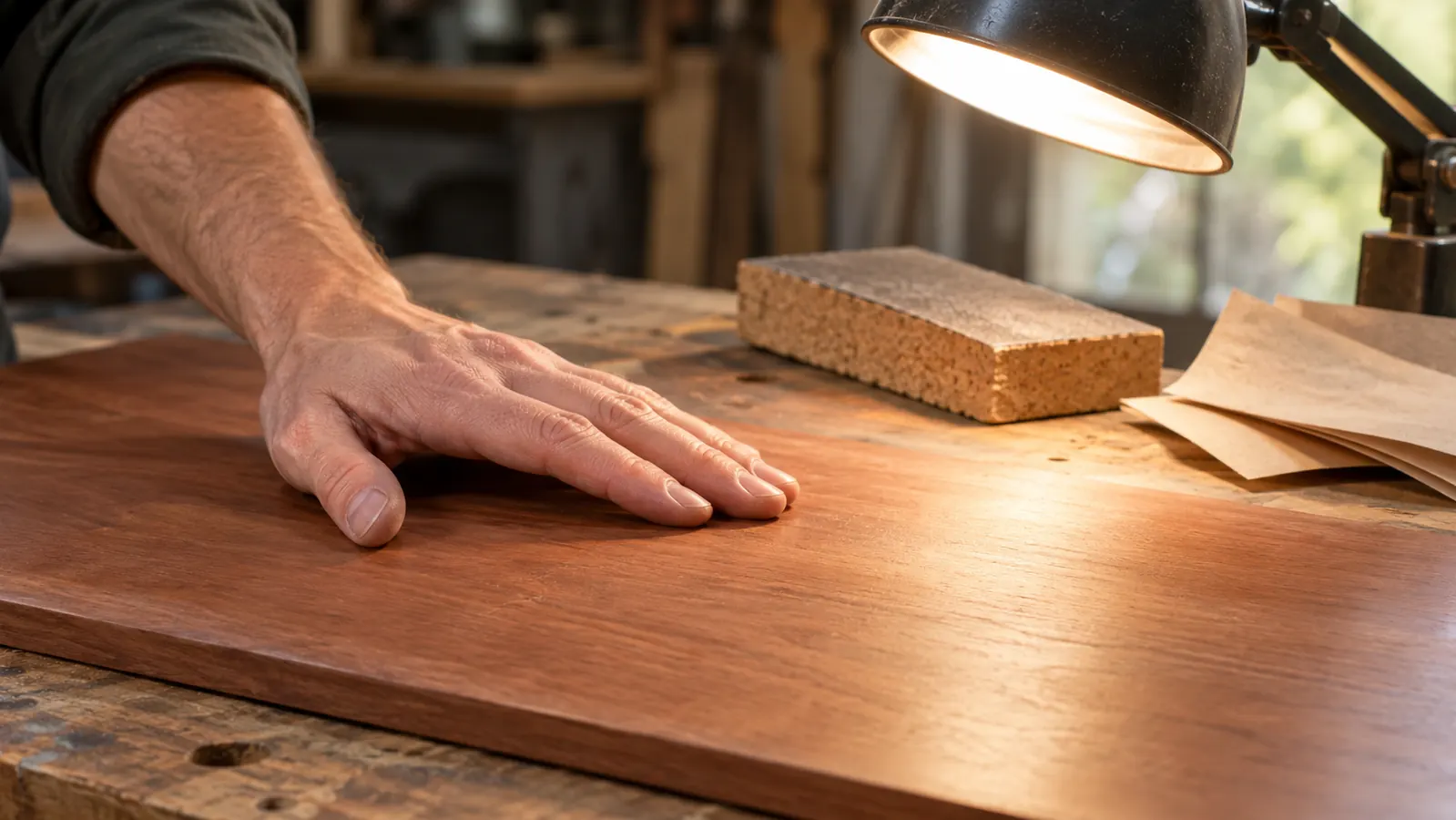
I sanded my first cherry blanket chest by hand, the way my father did it. A folded quarter sheet of paper, a cork block, and three Saturdays I am not getting back. My forearms ached for two days afterward. And after all of it there was still a shallow dip in the middle of the lid, right where I had leaned on the block harder than everywhere else.
These days the DEWALT DWE6421K does the flattening and I do the inspecting. That is the honest division of labor. My shop is a one-car detached garage, about twelve by twenty feet, with a wood stove in one corner, a shop vac and a portable dust collector fighting over the same outlet, and no room for a tool that only does one job badly. A 5 inch corded sander has to earn that footprint. Here are ten reasons the DEWALT earned its spot on my bench, plus the one job I still hand to paper.
The flattening is the machine's job
The DWE6421K is a 5 inch corded sander with a 3.0 amp motor turning the pad at 12,000 OPM. Kit includes the sander, a dust bag, and a carrying bag. Rated 4.7 out of 5 across 5,628 buyers, with a 3 year limited warranty behind it.
Amazon Check Today's Price on Amazon →You finish a tabletop in an afternoon instead of a weekend
A 24 by 48 inch glue-up is a lot of square footage to cover at 80, 120, 150, then 220 grit. Working by hand, that sequence ate a full Saturday and part of Sunday, assuming my shoulder held up. With the sander at 12,000 orbits a minute it is a long afternoon with daylight left to sweep up. Same paper, same grit progression, same result. The machine simply does not slow down in hour three, and my arm does.
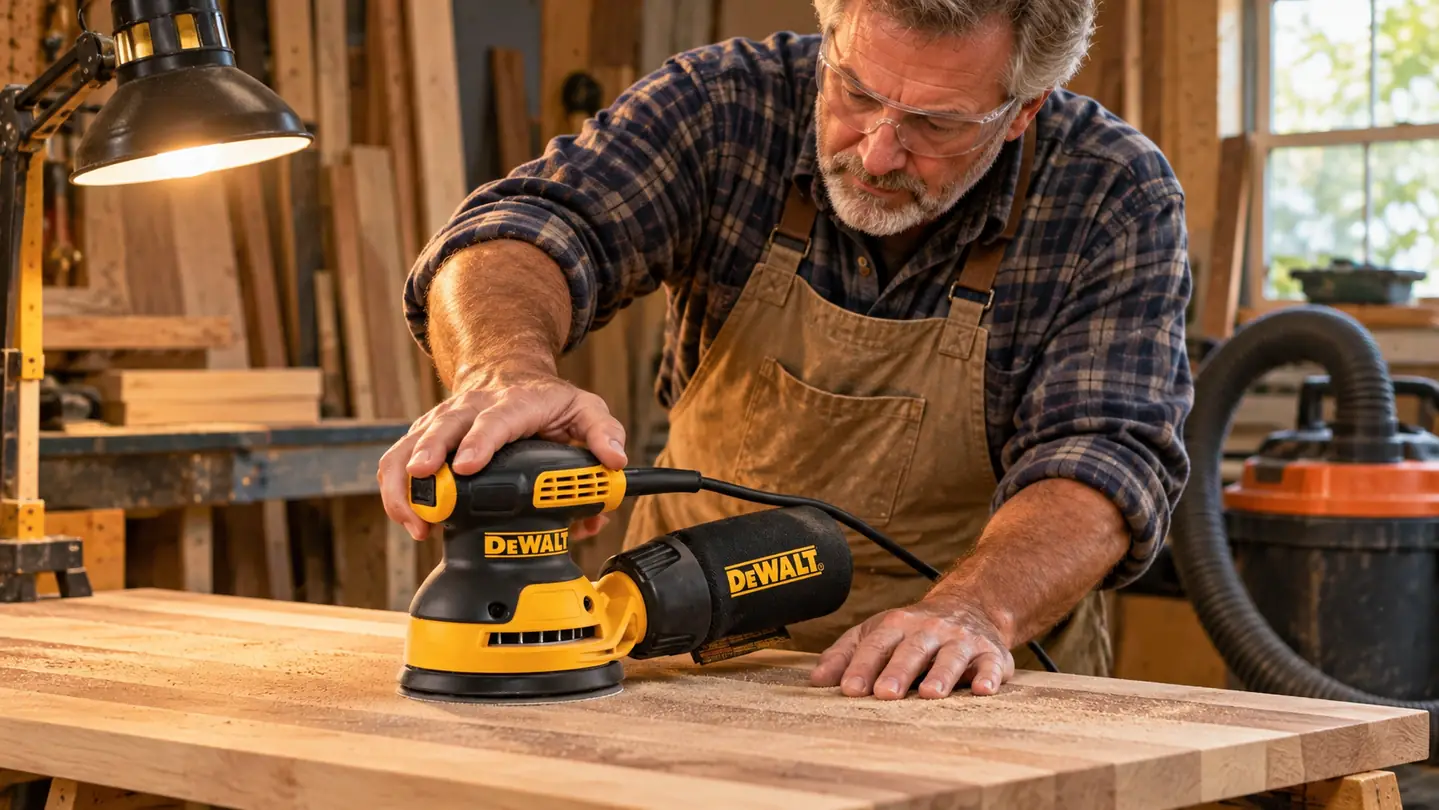
The 3.0 amp motor carries the pressure so my wrist doesn't
Hand sanding is a pressing contest and the wood usually wins. The 3.0 amp motor spinning the pad at 12,000 OPM does the abrasion on its own weight, which means I hold the tool flat and steer it instead of grinding down with my palm. That was also my biggest early mistake: pressing hard. It burns the paper, loads it up in a minute, and leaves the surface uneven. Let the tool float and the finish comes out flatter.
A separate counterweight keeps the buzz out of my fingers
Thirty years of hand tools left me with a touch of numbness in two fingers, and a harsh sander makes it worse by the end of a panel. The separate counterweight design in this DEWALT cuts the vibration down to something I can run for an hour without paying for it that night. Not zero. It is still a power tool and my hand tingles if I overdo it. But it is the first sander I have owned that I do not dread picking up.
The shorter height lets me see the swirls before the finish does
A shorter body puts your eye closer to the work, and that matters more than the spec sheet suggests. I sand with a raking light on purpose, a clamp lamp laid almost flat on the bench, because the scratches you miss show up the instant the first coat of finish hits. Being able to get down near the surface while the tool is still running means I catch cross-grain scratches while there is still paper left on the pad.
The rubber over-mold is where my hand actually sits
Sawdust on your hands turns a hard plastic grip into a bar of soap. The rubber over-mold in the critical areas of this sander covers the places my palm and thumb actually press. Two hours in, the tool still sits where I put it, dust and all. Small thing. It is also the difference between a tool you reach for and one you leave on the shelf until you are desperate.
The dust bag catches what a shop vac can't follow
Hand sanding throws the fine powder straight into the air, and my garage has a wood stove in it, so fine dust is not just a mess. The improved dust collection on this sander pulls most of the powder into the bag as it cuts. It is a bag, not a filtration system, and I still wear a respirator and run the shop vac afterward. But the difference in what settles on the bench overnight is one you can see with a flashlight.
The bag locks with one hand, so I actually empty it
Dust collection only works if you keep it working. A bag that fights you every time it fills is a bag that stays full, and once it stays full you are sanding in a cloud. The one-handed locking dust bag on the DWE6421K pops off and goes back on without me setting the tool down or hunting for a latch. I empty it every time I change grit. It takes ten seconds, which is why it gets done.
A dust-sealed switch survives a shop that is mostly dust
The switch is the part that quits first on a sander in a hobby shop, and it quits because dust gets inside it. DEWALT sealed the switch on this model against dust ingestion for longer switch life. Whether that buys me five years or ten I cannot promise you, but it is the right part to protect on a tool that lives in a garage with a wood stove and never sees a clean room.
Corded power means no battery clock in my head
It is a 120 volt corded tool, which in a twelve by twenty shop with outlets on two walls is the correct answer. I do not stop halfway through a tabletop to swap a pack, and I am not watching a light blink down while I still have three edges to go. The tradeoff is a cord to manage over the bench and around the work, and I will not pretend that is free. It just never runs out at the wrong moment.
The whole kit stores on a shelf in a small shop
The sander measures 10.08 by 7.23 by 6.24 inches, and the kit comes with the dust bag and a carrying bag. That is the entire footprint: one bag on a shelf above the bench, out of the way until I need it. In a garage where the table saw, the bench, and the stove are already arguing over floor space, a tool that packs down to a bag earns its place. The 3 year limited warranty covers it besides.
What I'd Skip
The obvious one: I would skip anybody who tells you hand sanding is finished. It is not. I still do corners, inside curves, and the profiles on a table leg by hand, because a 5 inch pad cannot get into a radius without rounding it over. I also sand between finish coats, lightly, with 320 on a cork block, and no orbital sander does that job for you. The machine handles the flat acreage. Paper handles the rest.
The second thing I would skip is buying a bigger sander for a small shop. A larger unit sounds better on paper until it lives on the floor because there is nowhere to set it down. And skip the urge to bear down on the tool. Weight of the sander, fresh paper, and patience. If your paper loads up in thirty seconds, you are pressing, not sanding.
A tabletop that used to eat a Saturday now takes an afternoon, and my shoulder does not complain about it the next morning.
Ten reasons, one outlet, one afternoon
If your bench is in a garage and your shoulder is not getting any younger, this is the sander I would buy again. 5 inch pad, 3.0 amp motor, 12,000 OPM, dust bag and carrying bag in the kit.
Amazon Check Today's Price on Amazon →