

For about thirty years, I sanded wood with my hands. A sanding block I cut from a scrap of maple, sheets of paper I tore into quarters, and a rhythm I could keep up for maybe twenty minutes before my fingers started to complain. I told myself it was the honest way. I told myself I could feel the surface better with paper against my palm.
Some of that was true. Most of it was stubbornness dressed up as craft. The turning point was a cherry blanket chest I built for my daughter. I had the case assembled and the top glued up, and then I spent four evenings on the same six square feet of cherry, going up through the grits, and by the last night my right hand was numb to the second knuckle and the finish still showed pigtails where I had leaned too hard in one spot. That was the week I bought a DEWALT orbital sander.
Four evenings on six square feet of cherry, and the finish still showed pigtails where I had leaned too hard.
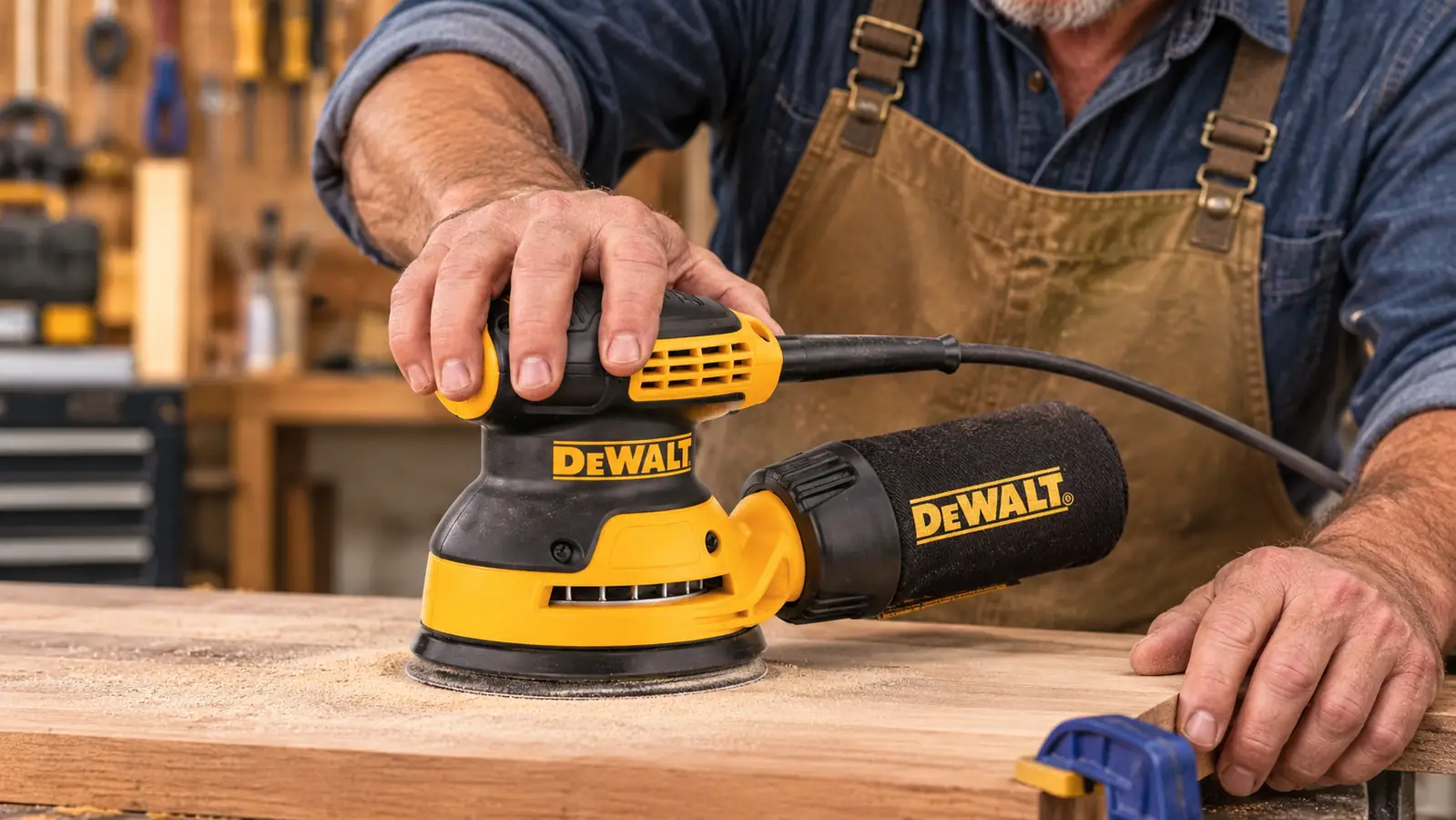
I want to be careful here, because I am not going to tell you a power tool made me a better woodworker. It did not. What it did was take the part of the job I was worst at, the long boring middle where you have to keep pressure perfectly even for an hour, and hand it to something with a motor and a counterweight. The DEWALT is a corded 5 inch orbital, 3 amp, and the pad spins at 12,000 OPM. Nothing fancy. That is the point.
The tool that ended four evenings of hand sanding on one chest top
Corded 3 amp orbital, 5 inch pad, 12,000 OPM, dust bag and carrying bag in the kit. It is the one I keep within arm's reach of the bench.
Amazon Check Today's Price on Amazon →The first thing I noticed was the height. DEWALT built this one shorter than the older sanders I had borrowed from a neighbor, and in a shop my size that matters more than it sounds. My bench sits at 34 inches, which is right for planing and wrong for sanding, so I end up leaning over my work no matter what. A shorter tool means my wrists sit closer to the surface and I can keep the pad flat instead of rocking it up on the back edge, which is what caused most of my pigtails in the first place.
The second thing I noticed was the vibration. There is a separate counterweight in this design and rubber over-mold on the grip areas, and after twenty minutes my hand was tired but not buzzing. With the borrowed sander I used to have to shake my hand out every few minutes. Now I do not think about it at all, which is how a tool should be.
Third thing, and this is the one I did not expect to care about: the dust bag. It locks on with one hand, and it actually holds. I still run the shop vac when I am doing a full panel, because a bag is a bag, but I am no longer walking out of the garage with a grey film on my glasses and a cough. The switch is dust-sealed too. I have had tools where the switch got gritty within a year and started needing a hard push. This one still clicks clean.
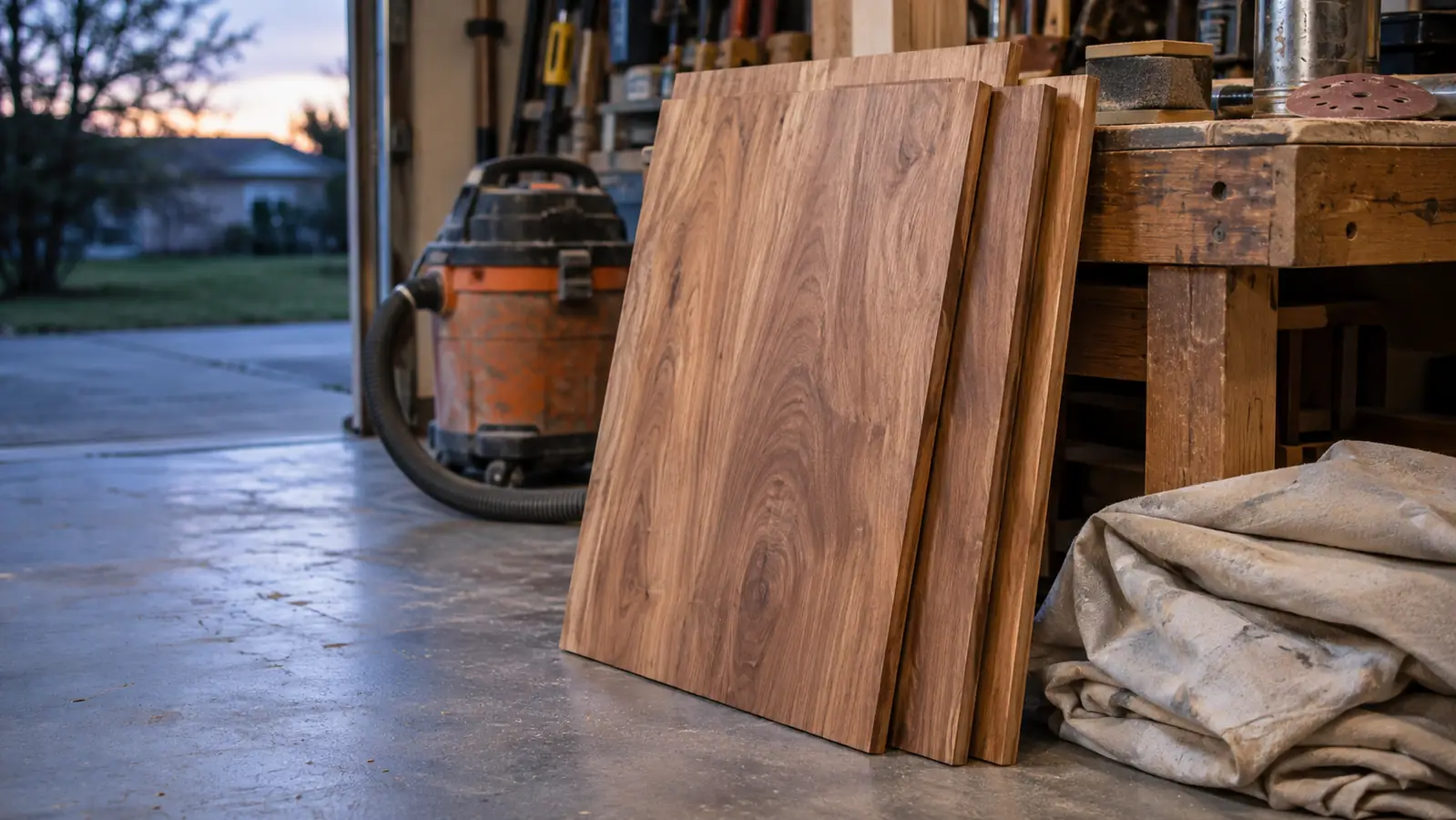
I made my share of mistakes with it early on. I pressed down hard, thinking pressure equals speed, and I burned through the edge of a walnut panel and had to cut it down and start over. An orbital sander does the work with its own weight and the grit, not with your shoulder. I also tried to skip grits, going from 80 straight to 220, and spent twice as long getting the scratch pattern out. The tool did not fail me there. I failed the tool.
What I'd Tell You If We Were Sitting at My Kitchen Table
I would tell you that a sander is not the tool that makes your work good. Your layout, your joinery, your patience with the finish, those matter more. But sanding is the step everybody rushes, and it is the step that shows in raking light, and if you are doing it by hand with a block on a piece bigger than a birdhouse, you are going to rush it. Not because you are lazy. Because your arm gets tired and you start leaning.
I would tell you to buy the kit rather than the bare tool, since it comes with the dust bag and a carrying bag, and corded rather than cordless if your bench sits within reach of an outlet, because you are not carrying a sander around a jobsite, you are standing in one spot for half an hour. I would tell you to let the tool sit flat and stop pushing. And I would tell you to buy more paper than you think you need, because the paper is the real consumable and everybody underestimates it.
I would also tell you the honest part. This is a corded tool with a cord that will find the corner of your bench at least once a session, and the bag fills faster than you want it to. It is not a finishing sander for tight inside corners, and it will not get into the bottom of a small box. For that I still use a block and paper, and I expect I always will. Three years of limited warranty is fine, and I have not had to use it.
Three decades of hand sanding, ended by one corded orbital
5 inch pad, 3 amp motor, 12,000 OPM, short body for leaning over a bench. If your arm is what gives out before your patience does, this is the fix.
Amazon See the DEWALT Orbital Sander Kit on Amazon →