

Every review of a trim router I read before I bought one told me the same three things. It is small. It is light. It spins fast. None of them told me the part that actually decides whether a tool earns its footprint in a 12 by 20 foot garage shop, which is what it feels like to hold a small motor in one hand at 35,000 RPM while the other hand pushes a board past a bit and nothing but your own attention keeps your knuckles clear. So that is the conversation I want to have here. This is the Bosch Colt PR20EVS, this is where it earns its keep, and this is where it will disappoint you if nobody warned you first.
The short version. The Bosch Colt PR20EVS is a fixed-base palm router with a 1.0 HP motor, 5.6 amps, and a variable speed range from 16,000 to 35,000 RPM. It weighs 3.3 pounds and stands about 7.5 inches tall. It takes 1/4 inch shank bits and it ships with a fixed base, a self-releasing collet chuck, and a straight edge guide. Those numbers are accurate and they are honest. What a spec sheet cannot tell you is which of them matter on a Saturday morning when you are rounding the edges of a bookshelf before supper, and which ones are there to sell the box.
The Quick Verdict
A quick, light, honest little router for edge work, hinge pockets and light trimming. The fixed base only, the 1/4 inch collet ceiling and a base plate that tips on narrow stock are the reasons it cannot be the only router on your shelf.
Amazon Check Today's Price →The router I grab for nine jobs out of ten, and the jobs it should not be asked to do
Small work, small motor, short setup. If your projects are edge profiles, hinge pockets and light trimming, this is the one that comes off the shelf. Check today's price before you decide.
Amazon Check Today's Price on Amazon →How I've Used It
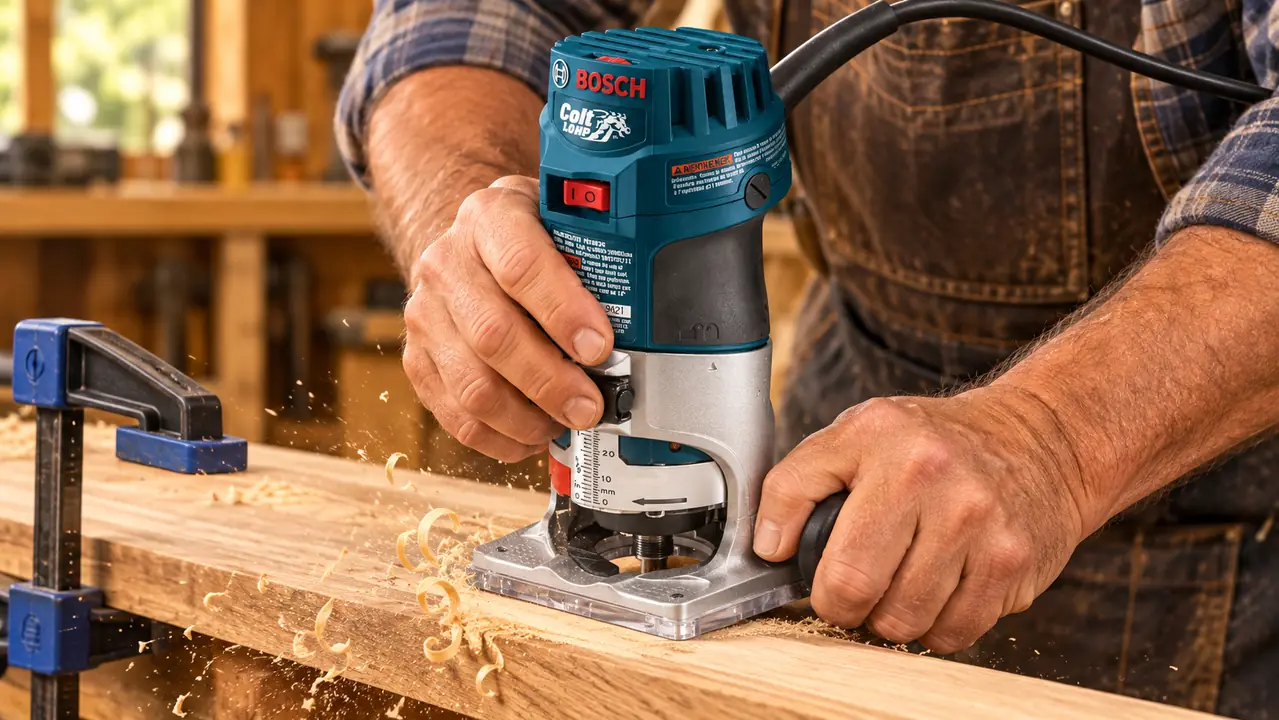
My shop is a converted one-car garage, maybe 12 by 20 feet, with a wood stove in the corner and a bench along one wall. Every tool on that bench has to do more than one job or it goes down to the basement shelf. The Colt has stayed out. In the past year it has rounded over the edges of four bookshelves, cut the hinge pockets on a pair of small cabinet doors, trimmed the banding on two end tables, and cut the juice groove in a maple cutting board my daughter took home. None of that is heavy work. All of it is work that a full-size router makes awkward, because you are holding 15 pounds of motor over a 30 inch board and trying not to let the thing tip.
The weight is the part I underestimated. At 3.3 pounds you can hold the Colt in one hand with a bit in it and steer it around a curve without your wrist complaining. That matters more than it sounds like it should. A palm router that fights your hand turns a ten minute job into a forty minute job with three test cuts in the middle, and then you stop reaching for it. I reach for this one.
The jobs I do not give it are just as instructive. I do not use it to raise a panel. I do not use it to cut a deep groove in white oak. I do not use it to trim a countertop where a straight bit has to hog off a quarter inch in a single pass. The motor is 1.0 HP and it will tell you so, loudly, if you ask it for work that belongs to a bigger tool.
Out of the box you get the motor, the PR001 fixed base, a 1/4 inch self-releasing collet chuck, a straight edge guide, and the wrench. The edge guide clamps to the base and lets you run the router along the edge of a board or up to 3-5/8 inch in from it. I used it once on a shallow channel for a bookshelf back and then went back to clamping a straightedge, because a guide that follows the board's own edge will follow the board's own wobble too. That is not a flaw in the guide. It is a fact about boards.
The Speed Control Is the Whole Point
Sixteen thousand to thirty-five thousand RPM is a wide range, and most people I know leave it at the top because the top is where it sounds like it is working. That is backwards for anything but small bits. Small bits in softwood at high speed cut clean. A larger bit in cherry at 35,000 RPM will scorch the edge before your hand has traveled four inches, and then you are sanding out a burn mark and blaming the tool. Turn the speed down, take a lighter pass, and move the board at a steady pace. The same router that burned the cherry cut it clean the second time with the speed backed off.
This is the part of the machine that separates it from the fixed-speed palm routers in the same aisle. A fixed-speed trim router has one gear and expects you to make it work. The variable speed on the Bosch lets you match the tool to the bit, and if you are working cherry, walnut or maple, that is not a luxury. It is the difference between a finish-ready edge and an afternoon with a card scraper.
Where It Falls Short
It is a fixed base. That is the biggest limitation and it is not a small one. With a fixed base you set the depth, start the motor, and lower the router onto the work. There is no plunge. To start a cut in the middle of a board you either tilt the router in, which is a bad habit and a worse cut, or you drill a starter hole and feed the bit down into it. If you want stopped grooves, mortises in the middle of a stile, or anywhere the bit has to enter the wood straight down, you are doing it with a workaround or with a different router. Bosch sells a plunge base separately, and if you plan that kind of work, price the base into the decision before you buy.
Depth setting is a measure, test, adjust, test again routine. There is nothing wrong with that and it is how plenty of good work has been done for decades, but do not expect to read a number off the tool and be finished. I keep a scrap of the same stock on the bench, cut it, check it with a straightedge and a square, and adjust. Two passes is normal. Three happens.
The base plate is small, which is the price you pay for the light weight. On a board wide enough to hold the whole base it is not an issue. On a 3/4 inch thick edge, or on a narrow face frame, the router wants to tip and the bit wants to climb. I hold it with two hands on narrow stock and I keep the board clamped so that if it does tip, nothing walks off the bench. If you do a lot of narrow work, a wider sub-base helps and it is worth the twenty minutes it takes to cut one.
If you are weighing this against the Makita RT0701C, the difference that matters most to me is the base situation. The Makita kit ships with more than one base. This one ships with the fixed base, full stop. That is the whole argument, and you can decide what it is worth to you.
The 1/4 Inch Collet Ceiling
The Colt takes 1/4 inch shank bits and the fixed base accepts bits up to 1 5/16 inch. That covers roundovers, chamfers, cove bits, flush trim bits, small straight bits, hinge mortise bits, and the core box bit I used for the juice groove. It does not cover the 1/2 inch shank bits a lot of us have accumulated, and it does not cover anything with real mass on the end of it. There is no adapter that turns this into a 1/2 inch router, no matter what a listing title hints at.
I have a full-size router for the 1/2 inch work, and I expect most people reading this do too, or will. If you do not, be honest with yourself about what you are buying. This is a second router, or a first router for someone whose projects are small. It is not a substitute for the big one, and trying to make it one is how a motor gets burned out and a decent tool gets blamed for a job it was never built to do.
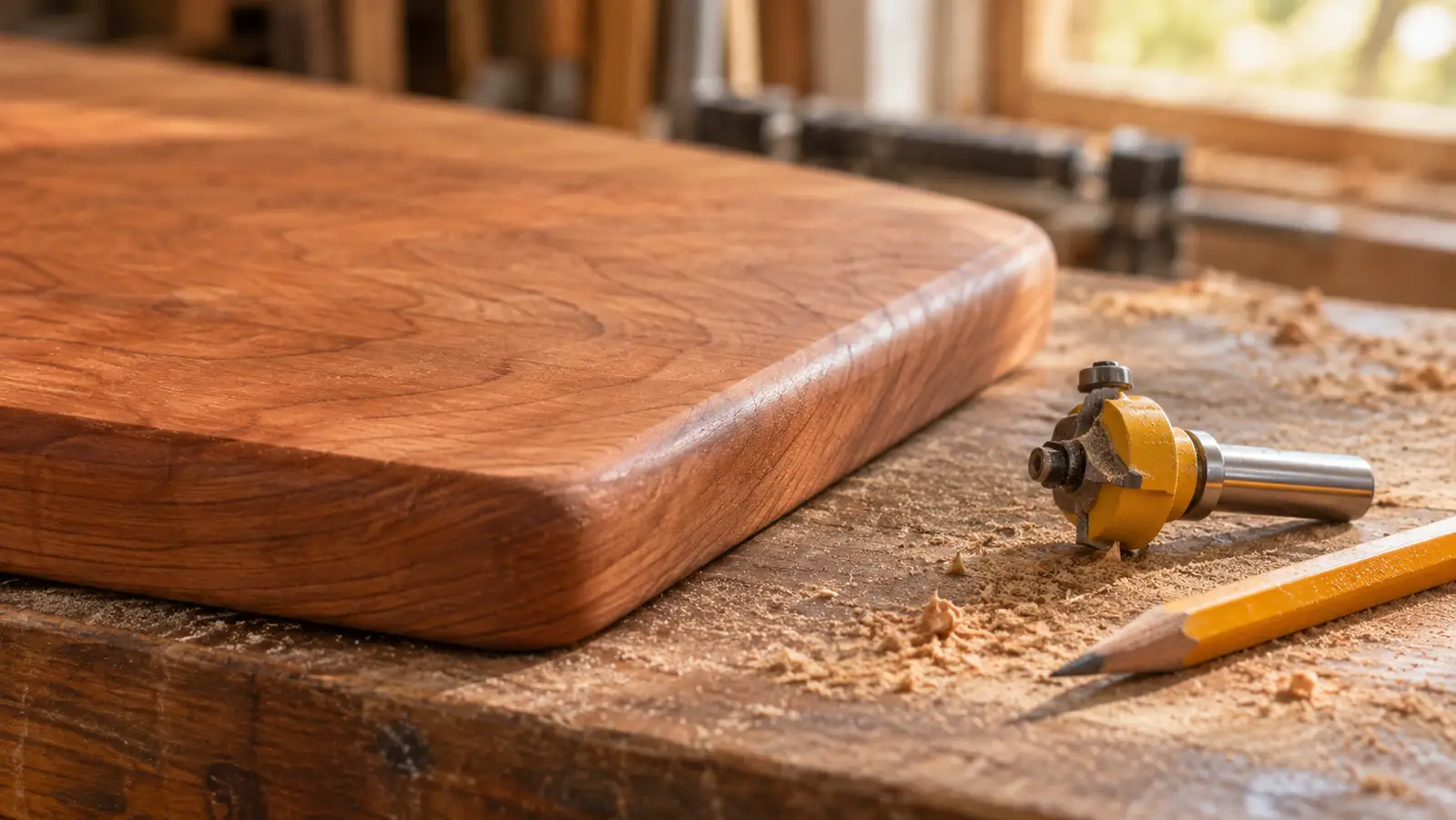
A larger bit in cherry at top speed will scorch the edge before your hand has traveled four inches. Backed off to a lower speed and a lighter pass, the same router cut the same edge clean.
Dust, Noise, and the Reality of a Small Shop
There is no dust port on this base, so the chips go where they go. In a garage shop with a wood stove in the corner, that means I sweep more than I would like and I keep the shop vac close by. Routing is not a clean operation anyway, but a trim router with no collection throws chips at your forearms and across the bench, and a pass along a nine foot bookshelf edge leaves a line of spoil you will be picking out of your shirt later.
The noise is what you would expect from a small motor spinning at 35,000 RPM. It is high and it cuts through hearing protection that is adequate for a table saw. I wear plugs and muffs together when I run it for more than a few minutes, and I do not run it without glasses on. That is not a knock on the tool. It is a knock on how people use small routers, which is casually, because they feel harmless. They are not harmless. A 1/4 inch bit at 35,000 RPM does not care that the router weighs 3.3 pounds.
What the Quick-Clamp System Actually Does
The quick-clamp system is the part of the design that gets the least attention in reviews and the most use in my shop. It is how the motor locks into the base. Release the clamp, the motor lifts free, and you can set the base down flat on the bench while you deal with the bit or the depth. On a router this size you change the setup more often than you change a bit on a big one, because the whole point is doing five small jobs in an afternoon, and a clamp that works without hunting for a wrench saves you a minute every time.
It is not a feature that will sell anyone on the tool. Nobody buys a palm router because the clamp is convenient. But it is part of the reason the thing stays out on the bench instead of going back in a box, and that is the only test that matters on a 12 by 20 foot floor with no spare room for a tool that is a nuisance to set up.
What I Liked
- 3.3 pounds, so one-handed edge work does not wear out your wrist
- Variable speed from 16,000 to 35,000 RPM lets you match the speed to the bit and the wood
- Quick-clamp system makes moving the motor out of the base a tool-free job
- Straight edge guide included, and it reaches up to 3-5/8 inch in from the edge
- Fixed base accepts bits up to 1 5/16 inch, which covers most common profiles
- Self-releasing collet chuck lets go of the bit when you loosen the nut
Where It Falls Short
- Fixed base only, with no plunge, so stopped cuts in the middle of a board are a workaround
- 1/4 inch collet only, so 1/2 inch shank bits are out
- Small base plate wants to tip on narrow stock
- No dust port, so chips go where they go
- Depth changes are cut and check, not read and set
- One year limited warranty is the minimum I would expect in this class
What I Would Change
Two things. I would like a base with a little more footprint so narrow work does not feel like a balancing act, and I would like a way to hook a shop vac to it without inventing something in the shop. Neither of those is on the base that comes in the box, and both are things I would pay more for. The warranty is one year limited, which is the floor of what I would expect on a tool in this class and not a reason to celebrate.
What I would not change is the size and the weight. I have used bigger trim routers and every one of them traded away the thing that makes this one useful. If Bosch made this heavier and wider to fix the tipping, I would stop reaching for it, and then it would be a tool sitting on a shelf proving a point. Tools earn their place by getting used.
Who This Is For
This is for the home woodworker with a bench against a garage wall who already owns, or plans to own, a full-size router for the heavy work. It is for cutting board edges, small cabinet doors, drawer fronts, shelf nosings, hinge pockets, flush trimming, and the kind of repair job a neighbor brings over on a Sunday. If your projects fit on a bench and your stock is mostly 3/4 inch, this router will do most of what you ask and it will not tire your arm doing it. It is also a reasonable first router for someone building birdhouses, toys and small boxes who has no intention of raising a panel in this lifetime.
Who Should Skip It
Skip it if you want one router to do everything. Skip it if your bit drawer is full of 1/2 inch shank bits, or if you plan to cut raised panels, deep mortises, or stopped grooves in the middle of wide boards. Skip it if you do not want to own two routers, because that is what this purchase usually turns into, and it is better to know that going in than to find out halfway through a project with the wrong tool clamped to your bench.
Buy it for the small work and keep the big router for the rest
That is the honest division of labor. The Bosch Colt PR20EVS is a light, quick, variable-speed palm router that earns its shelf space as a second router, not a first and only. Check today's price and see whether the numbers line up for the work you actually do.
Amazon Check Today's Price on Amazon →