

The first thing I noticed about the DEWALT DWE6421K was not the motor or the dust bag. It was how close my hand sat to the board. I am 66, retired from the union electrical trade, and I work out of a 12 by 20 foot garage shop outside Philadelphia. Space is tight. Every tool has to earn its footprint. I have had this 5 inch corded orbital sander in the shop since the spring of 2024, and I have used it on pine, white oak, cherry, and a few reclaimed boards that had more nails than I care to admit.
This is not a love letter. The DEWALT DWE6421K is a good sander with a few annoyances that the listing photos do not show. The dust bag is helpful but not a dust collector. The vibration is controlled but not gone. The paper changes are simple, but the pad and the bag demand attention. If you are shopping for a first orbital sander for a small shop, those are the things you need to know before you plug it in.
The Quick Verdict
A plain 5 inch workhorse for flat work, with a dust bag that helps instead of solves and a vibration level you will feel by dinner.
Amazon Check Today's Price →A corded sander that earns its shelf space, quirks included
The DEWALT DWE6421K is a 3.0 amp, 12,000 OPM orbital sander with a dust bag, a carrying bag, and a 3 year limited warranty. I will get into the dust and vibration issues below, but this is the one I reach for on most flat work.
Amazon See the DEWALT DWE6421K on Amazon →How I've Used the DEWALT DWE6421K
I did not buy this sander to build heirloom furniture. I bought it because my old quarter-sheet sander was slow, and my hands were tired of chasing swirl marks. The DEWALT has a 3.0 amp motor and spins the pad at 12,000 OPM. On paper those numbers are ordinary. In the shop they mean the sander keeps moving when I lean into a board, but it does not remove stock like a belt sander. That is the right balance for cutting boards and end tables.
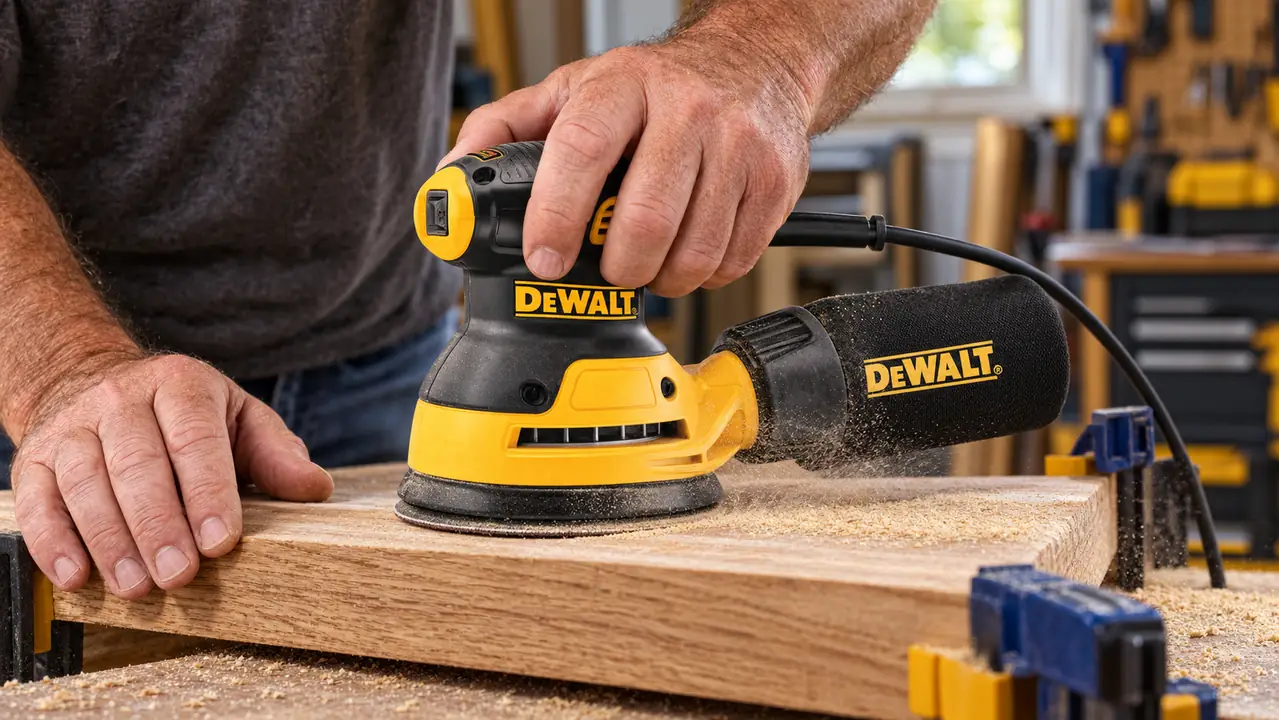
My first real job with it was a maple cutting board glue-up that had a slight step between two strips. I clamped the board to the bench, put a medium grit on the 5 inch pad, and let the sander do the work. It flattened the joint in a few passes. The shorter height of the body kept my palm close to the work, which made it easier to keep the pad flat. I did not have to fight the tool to keep it from tipping.
I also used it on a cherry blanket chest for my daughter Jen. That project took several weekends. The sander ran for long stretches, and the dust bag filled faster than I expected. I emptied it, tapped it out, and kept going. The bag is one-handed to lock and remove, which sounds like a small thing until you are holding a board with one hand and trying to reattach a bag with the other. It did not fight me.
My grandson Tyler, who is 12, helps me on some Saturdays. He wears safety glasses and stays on the other side of the bench until I say otherwise. I let him run the sander on a scrap pine board with the cord draped over my shoulder so it would not catch. The rubber over-mold gave him a decent grip, and the tool did not jump. That is not a reason to hand a power tool to a child, but it is a reason to appreciate a sane handle.
What the DEWALT Gets Right
The 3.0 amp motor is not the biggest in the class, but it holds speed under a light load. I noticed it most on white oak, where cheaper sanders bog down and leave little swirls because the pad slows under my hand. The DEWALT kept a steady 12,000 OPM as long as I did not bear down like I was trying to plane the board. That is the lesson with any orbital sander: let the paper cut, not your shoulder.
The separate counterweight is the reason the tool does not buzz like a cheap electric toothbrush. DEWALT built the sander with a counterweight that offsets the pad, and the rubber over-mold sits where my palm and fingers land. After a 45-minute session on a bookshelf, my hand was tired but not numb. I have used sanders that left my fingers tingling for an hour. This one did not.
The dust-sealed switch is another detail I did not think about until I had sawdust all over the bench. The switch is built to keep fine dust out of the contacts. I have had switches on other tools get gritty and start sticking. The DEWALT switch still moves cleanly. That is a small reliability point, but in a garage shop with limited heat and a lot of dust, small reliability points matter.
What Nobody Tells You About the Dust Bag
The dust bag is the part of the DEWALT DWE6421K that gets the most attention in reviews, and most of that attention is too generous. The bag collects a lot of the fine dust, especially when you keep the pad flat and do not overrun the edges. But it is not a dust collector. After two hours on the cherry chest, I still had a film on the bench and a tickle in my throat. I wear a respirator when I sand anyway. If you do not, start.
The bag is small. That is the tradeoff for a bag that does not hang off the back like a vacuum hose. On a long sanding session, I empty it every 20 to 30 minutes. The one-handed locking bag makes that easy. I can pop it off, dump it into the shop vac, and snap it back on without setting the sander down. But if you are sanding a large project, plan on emptying it more often than you would like.
The bag also does not replace a shop vac at the source. I have a small portable dust collector and a shop vac in the shop. When I sand inside, I hook up the vac if I can, or I move the work near the garage door and set a fan behind me. The DEWALT bag cuts down the cloud. It does not make sanding clean. Nobody should expect a bag to do that, but the product photos make it look like a closed system. It is not.
The Vibration Question
DEWALT says the separate counterweight reduces vibration, and that is true compared with the cheap quarter-sheet sander I used for years. But it is still a hand sander. If you sand a vertical surface or hold the tool overhead, you will feel it in your wrist. I sanded the inside of a bookshelf carcass last winter, and after 20 minutes my forearm was talking to me. I had to stop, stretch, and come back.
The rubber over-mold helps. I have a dry shop in the winter, and my hands crack. The over-mold gives me something to hold that does not slip when my palm is dry. The grip is not soft and squishy. It is firm. That is fine with me. A soft grip on a sander can make you hold it tighter, which is the opposite of what you want.
My advice is to keep your grip loose and let the tool float. If you white-knuckle it, the vibration goes into your arm and the pad tips. I learned that the hard way on a pine shelf. I pressed down, the sander dug in at the edge, and I took a divot out of the board. I had to cut the shelf down and start over. The tool did not do that. I did.

Paper Changes and Pad Life
The DEWALT takes 5 inch paper. I keep a stack of 80, 120, and 220 grit in a drawer under the bench. The paper change is not a wrestling match, but it is not instant either. I line up the paper, press it flat, and check the edges. If the paper hangs over the pad, the edge will flap and tear. If it is too small, it will not cover the pad and the pad will wear unevenly.
The pad itself is a wear item. After about a year of weekend work, I noticed the pad was not holding paper as well as it used to. I cleaned it with a brush and a little compressed air, and that helped for a while. Eventually I replaced it. That is normal. A sander pad is like a brake pad. It does a job and it wears out. Do not buy a sander thinking the pad will last forever.
The 5 inch size is the sweet spot for a small shop. A 6 inch sander covers more area, but it is heavier and harder to control on narrow stock. A quarter-sheet sander is better for corners, but it is slower on flat panels. The DEWALT sits in the middle. It is not the fastest way to remove stock. It is a good way to get a flat panel ready for finish without tearing up the wood.
Where It Falls Short
The cord is the first thing. It is a corded sander, and that is fine, but the cord is stiff in cold weather. My shop has a wood stove, and the first hour in January is not warm. The cord does not want to lay flat. I have to flip it over my shoulder and keep it behind me so it does not drag across the wet finish on the next board. A cordless sander would be handier, but I do not want another battery platform. I accept the cord. I just do not like it.
The dust bag is the second. I already covered it, but it belongs on the short list. The bag is a catcher, not a collector. If you are sensitive to dust, budget for a shop vac and a hose. The sander does not come with a hose. It comes with the sander, the dust bag, and a carrying bag. That is it. Do not expect an adapter for your vac in the box.
The third is the lack of a case that organizes paper. The carrying bag is fine for the tool and the bag. It is not a paper organizer. I keep paper in a separate plastic bin. That is a small thing, but a small shop runs on small systems. If a tool comes with a bag, I want the bag to hold the paper too. This one does not.
The fourth is the weight and balance. The DEWALT is not heavy, but it is not a one-hand tool for long sessions. The shorter height helps, but the motor and the bag sit above the pad. If you tilt the sander, the bag pulls the balance back. I keep two hands on it for anything wider than a few inches. That is not a defect. It is the nature of a block sander.
What I Liked
- 3.0 amp motor holds speed on flat panels
- 12,000 OPM helps flatten glue-ups without a belt sander
- Shorter height keeps your hand close to the work
- Dust-sealed switch and rubber over-mold are real shop details
- One-handed dust bag is easy to empty
- 3 year limited warranty
Where It Falls Short
- Dust bag is small and fills fast
- Vibration still adds up on vertical work
- Cord is stiff in a cold shop
- No vac hose or adapter in the box
- Pad wears and needs replacement
The DEWALT DWE6421K is a good sander, but the dust bag is a catcher, not a collector. If you sand in a garage with the door closed, you still need a respirator and a vac.
Who This Is For
This sander is for the home woodworker who needs one corded orbital sander for flat work. It is for cutting boards, table tops, shelves, cabinet doors, and small repair jobs. It is for a shop where space is tight and the tool has to fit on a shelf or in a bag. It is for someone who already has a shop vac or a dust collector and knows that the bag is a first pass, not the final answer.
It is also for the person who does not want to learn a new battery system. The DEWALT DWE6421K runs on 120 volts and a cord. That is simple. I plug it in, flip the switch, and sand. There is no battery to charge, no fuel, no app. For a retired electrician who spent 30 years around motors, that simplicity is a feature.
Who Should Skip It
Skip it if you need to remove a lot of stock fast. This is an orbital sander, not a belt sander. It will flatten a glue-up, but it will not take a twisted board down to thickness in a hurry. If you are building a workbench top from rough lumber, you need a planer and a jointer, or a belt sander and a lot of patience. The DEWALT is the wrong tool for that job.
Skip it if you sand for hours at a time and your hands are sensitive to vibration. The counterweight helps, but it does not make the tool vibration-free. If you have nerve issues or you sand overhead, look at a random orbit sander with a better grip and a smaller profile, or break the work into shorter sessions. Skip it if you refuse to wear a respirator. The bag is not enough. The dust you cannot see is the dust that hurts you.
The sander I would put on my own bench again
If you need one corded 5 inch sander for flat work and you already have a way to manage dust, the DEWALT DWE6421K is a sensible choice. It has the power for glue-ups, the shorter height for control, and a 3 year limited warranty. Just do not expect the bag to replace a respirator.
Amazon See the DEWALT DWE6421K on Amazon →