A four-pack of small bar clamps is not the tool you daydream about. It is the tool you grab twenty times on a Saturday and never think about again, right up until one of them lets go in the middle of a glue-up and you find out what your joints look like without pressure on them. I have had this set of IRWIN Quick-Grip one-handed mini bar clamps on a nail above my bench for a few years now, and I have a fair amount to say about them, not all of it kind.
Short version first. This is a pack of four 6 inch one-handed clamps with a resin body over a hardened steel bar, a trigger that works with one hand, padded jaws, and a full lifetime guarantee. They are the best thing in my shop for holding small parts and the wrong tool for a wide panel. If you came for the article where every clamp is wonderful, this is not that article.
The Quick Verdict
The right clamp for small assemblies and the wrong one for anything wide. Buy them for what they are, not for what a longer clamp does.
Amazon Check Today's Price →Four small clamps that stay on the bench instead of in a drawer
A 4-pack of 6 inch one-handed clamps with padded jaws, 140 pounds of force, and a lifetime guarantee. Almost every small assembly in a home shop wants one of these.
Amazon Check Today's Price on Amazon →What You Are Actually Buying
The box holds four clamps, each with a 6 inch bar. What that means in practice is that the number describes the clamp, not how far it reaches into a carcass, and anybody who has bought clamps by the label knows those are two different things. On my bench these handle stock about the size of a drawer side, a birdhouse wall, or a picture frame corner. Past that, I am reaching for something longer.
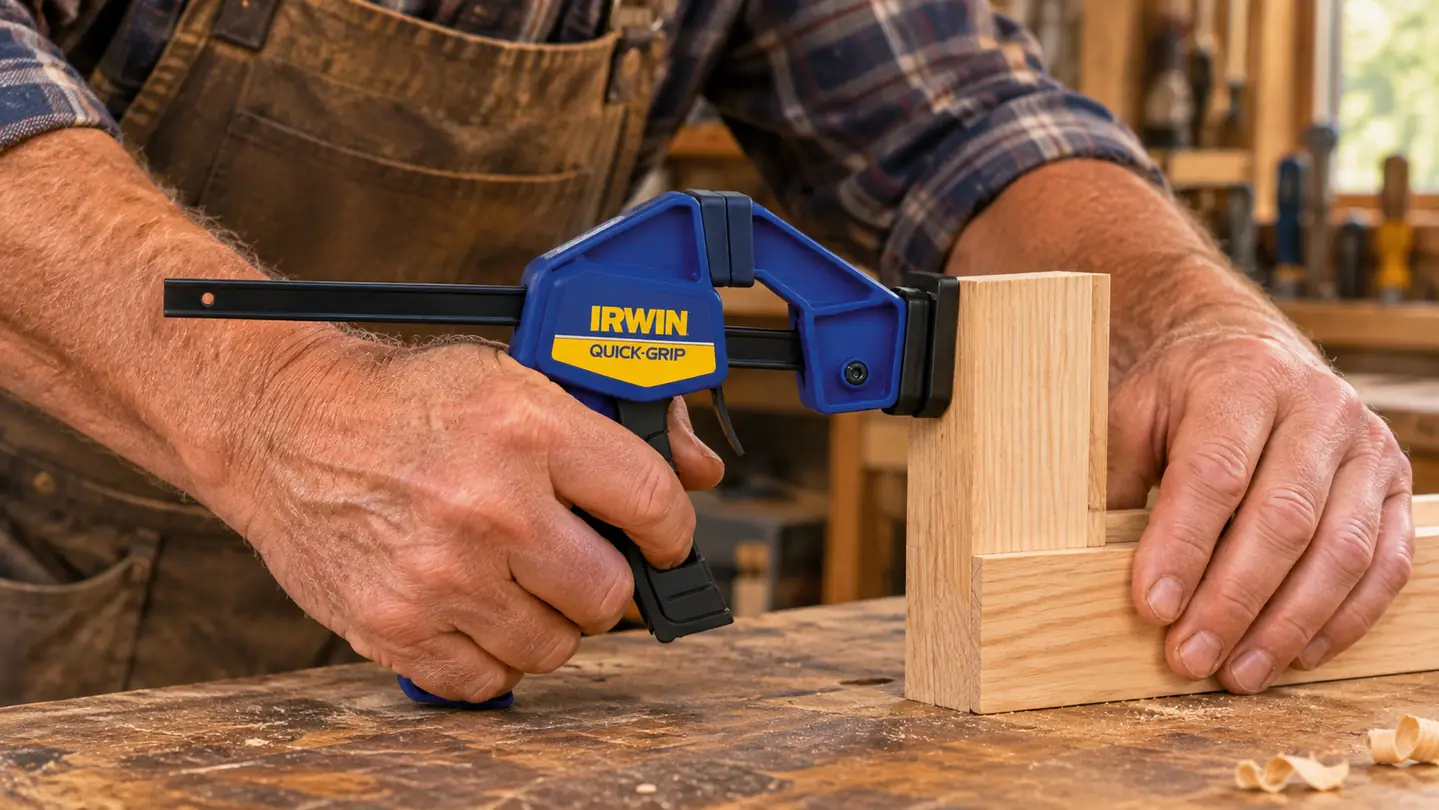
Construction is resin over a hardened steel bar, which the listing gives as the reason the clamp resists flexing and bending. The jaws carry pads, and the listing claims they grip firmly while protecting the work from scratches and scuffs. My experience matches that on bare wood. The release is a trigger, so the clamp opens instantly instead of being wound off a thread a half turn at a time.
Size is the quiet part of the sales pitch. There is no threaded handle swinging around, no long bar hanging off the bench, no clamp that wants a clear space around it before you can set it. In a shop where the bench is also the assembly table, the finishing table, and the place where the shop vac sits when I am not using it, that matters more than a force rating on the side of a box.
How I've Used Them in a 12 by 20 Foot Shop
My shop is a one-car garage I converted years ago, about twelve feet by twenty, with a wood stove in the corner for January and a shop vac hooked to whichever machine is making the most mess that day. Space is the whole argument in a room that size. A clamp that lives on a nail and comes off with two fingers earns its footprint. A clamp that needs a clear square foot around it does not, no matter how well it is made.
Where these come off the nail most is small assembly. Birdhouse gables with my grandson Tyler on a Saturday morning, picture frame corners, small boxes for the repair jobs neighbors drop off, and the hold-down jobs where you need a third hand for ninety seconds and nobody is coming. Two of these and one free hand beats waiting for help to wander into the garage.
They also work as bench helpers. Clamp one to the edge of the bench and it becomes a stop, a temporary fence for a run of small parts, or a holder for a jig while you get it set. The one-handed trigger is the entire reason that works, because you can adjust the position while the piece is already sitting where you want it. The Eagles have not given me much to cheer about in years, but these clamps have held up better than my patience with the offensive line.
Where They Genuinely Earn Their Keep
Confined areas. The listing puts it plainly, clamping smaller workpieces and working in confined areas, and that is the honest description. Inside a drawer box, inside a carcass, behind a face frame, these fit where a longer bar will not go or will not stay put. That is a real advantage and it is the reason I keep four of them instead of one.
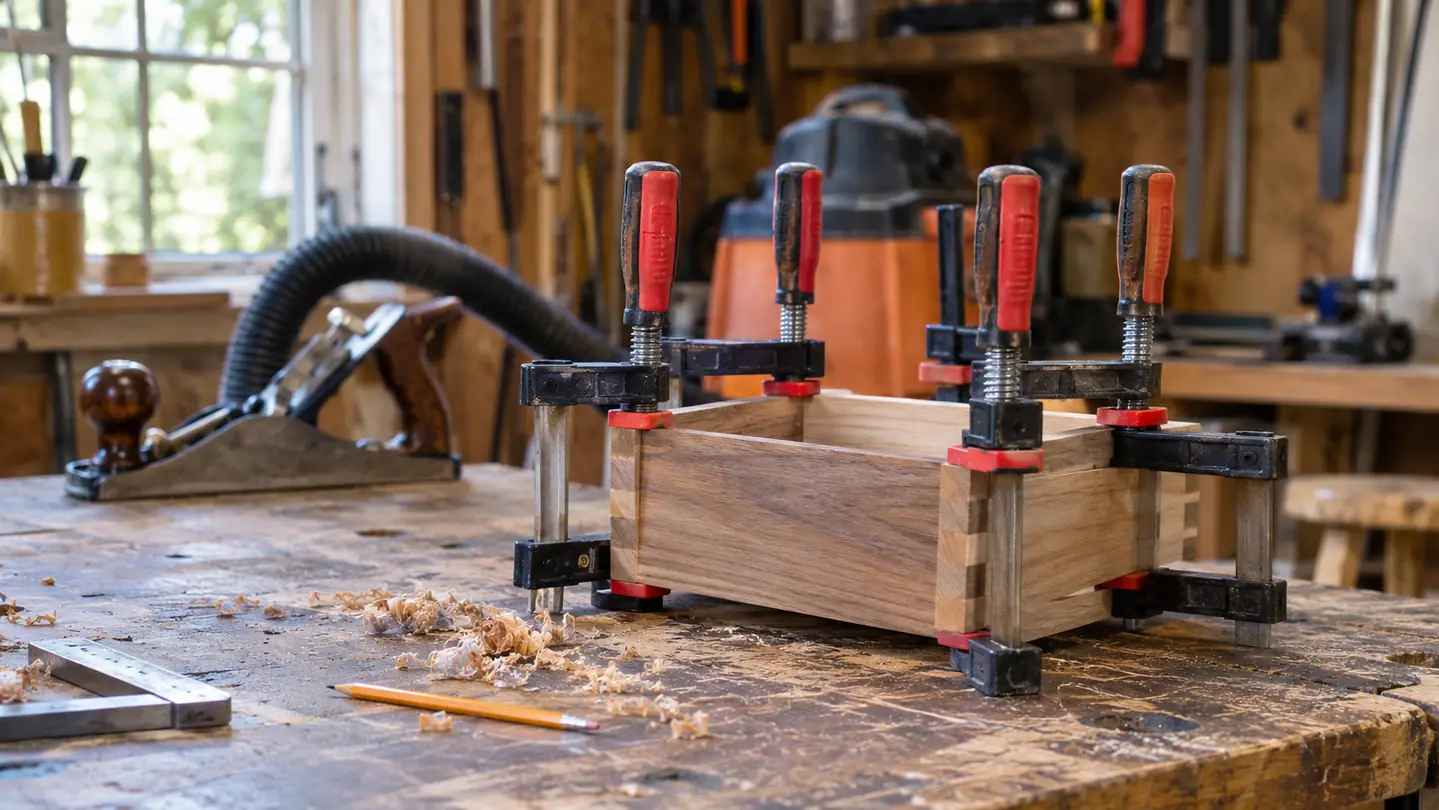
Short glue-ups. If the joint closes in one squeeze and stays closed, these are fine. I have glued up small boxes with four of them and come back an hour later to square corners. The padded jaws did not mark the cherry, which is more than I can say for the bare steel jaws on the older clamps rattling around in the bottom of my clamp bucket.
Holding parts while you fasten them. Brad nails, pocket screws, one screw into a cleat. The clamp holds the alignment and your hands stay on the driver. On small work that is faster than the vise and less fuss than setting up bench dogs. Honestly, this is how I use them more than any other way.
I have glued up small boxes with four of these and come back an hour later to square corners, with no jaw marks on the cherry.
What Nobody Tells You: The Limits
They are small clamps and they act like it. Six inches of bar means six inches of clamp, and the reach past the bar is limited. If you are clamping the middle of a bookcase side, this is not the clamp, and no amount of clever positioning will turn it into one. I have tried. I have also watched one of these slide off a slick corner because I wanted it to work more than it wanted to stay.
The body flexes when you lean on it. The hardened steel bar keeps the clamp from folding up the way a cheap wooden cam clamp will, but the body is resin, and 140 pounds of force is not the same as what you can put into an F-style clamp with a threaded handle. On a joint that wants to spring open you will feel the clamp give before the joint closes. That is not a defect. That is what a small one-handed clamp is, and the listing does not pretend otherwise.
The pads slip on finished surfaces. On bare wood they grip fine. On waxed or lacquered stock, or anything with a chamfer, expect to chase the clamp a little. I keep a scrap of leather and a folded piece of 120 grit paper within reach when I am clamping something finished. It takes five seconds and it saves the surface.
Your hand gets tired. A trigger clamp works by squeezing, and by the twelfth clamp in a session my grip is done for a while. That is not a knock on the tool, it is a reason to own four. With four you can set them all before the glue goes on, then close them one after another. A screw handle is slower but it does not wear out your forearm.
One more small annoyance. The pads protect against scratches and scuffs, but they do not make soft pine any harder. Lean on that trigger with everything you have and you can still leave a shallow dent in white pine. I did it on a toy box lid and had to sand it out. Squeeze until the joint closes, then stop squeezing.
The 140 Pound Question
IRWIN lists 140 pounds of force, and a nearby bullet mentions distributing 150. I do not know what the second number is measuring, and I suspect nobody reading that bullet does either. What I can tell you is what 140 pounds feels like on the bench. It closes a small box, holds a cleat while the glue sets, and keeps a birdhouse wall from wandering while you drive brads. It does not pull a cupped board flat.
That distinction is the whole review. A clamp is a device for holding something still, and the only question that matters is which something. Small parts, yes. Wide panels, no. Buy these expecting them to do the work of a 24 inch bar clamp and you will be disappointed, and you will blame the clamp for doing exactly what it said it would do.
How They Compare With the Rest of the Wall
Spring clamps are faster to put on and useless for anything that needs real pressure. Wooden cam clamps are pleasant to use and costly, and the jaws on mine have marked softwood more than once. F-style clamps are the ones you want for casework, and they are slow to set with one hand because there is a handle to turn. These IRWIN clamps sit in the gap between a spring clamp and an F-style clamp, which is where most of my actual work happens.
The honest comparison is that I own all four kinds and I use all four kinds. A shop that owns one style is a shop that improvises with wedges and weights. If you are starting out and can only buy one thing this month, buy two 24 inch F-style clamps. If you already have those, this four-pack is the next thing I would hang on the wall, and I would hang it above the bench where it is easy to reach.
There is also the question of four versus one. One clamp is a clamp. Four clamps is a method. When a small assembly has to go together in one motion with glue already open, having four set and waiting turns the job from a scramble into a sequence. I noticed that the first month I owned them and I have not stopped noticing it.
How They Hold Up, and the Guarantee
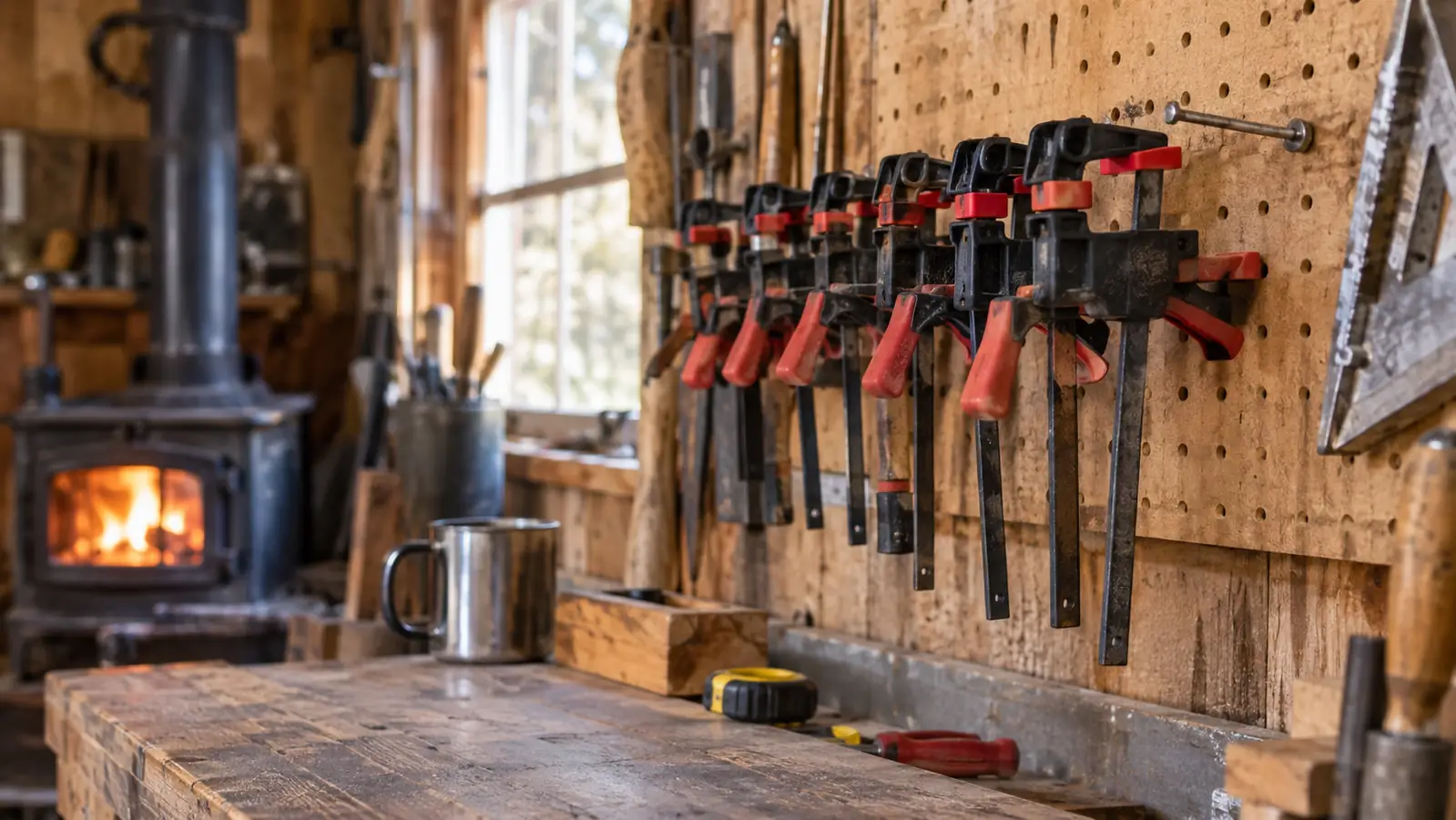
Mine have been on a nail for a few years, through summers where the garage hits ninety-five and winters where the wood stove keeps it just above freezing. The bars have not rusted past a haze, the triggers still snap, and the pads are still on the jaws. The resin bodies have a few scuffs from being dropped on concrete, which is what happens to everything in a garage.
IRWIN backs these with a full lifetime guarantee against defects in material and workmanship. I have never had to use it, so I cannot tell you how the claim process goes. What I can tell you is that a clamp at this level with a lifetime guarantee behind it is a fair bet for a home shop, because the usual failure on cheap clamps is the jaw or the bar, and both are covered.
A Job Where They Beat the Long Clamps
The cherry blanket chest I built for Jen took a lot of clamps and almost none of them were these. The carcass wanted 24 inch bars and got them. What these did was the corner blocks and the cleats for the bottom, inside the box, where a long clamp simply will not fit and where I needed to hold a block in place with one hand while the drill ran with the other. That is the job these were made for, and they did it without complaint.
What I Liked
- One-handed squeeze with a trigger release, so you can position and set the clamp with the same hand
- Four in the pack, which covers most small glue-ups without buying a second set
- Padded jaws gripped cherry and pine without leaving marks
- Fits inside drawer boxes, carcasses, and other places a long bar will not go
- Hardened steel bar resists the flexing that short clamps usually show
- Full lifetime guarantee from IRWIN
Where It Falls Short
- 6 inch bar limits reach and rules out panel work
- Resin body flexes before a stubborn joint closes
- Pads slip on waxed or lacquered surfaces
- Hand fatigue after a dozen clamps in one session
- Not a replacement for F-style clamps on casework
Who This Is For
The home shop with limited space and a mix of small work. If your week is birdhouses, boxes, drawer parts, picture frames, jigs, and the neighbor's broken kitchen chair, four of these on a nail will get used constantly. Tyler and I built six birdhouses last spring and I do not think we finished one without reaching for these. In a twelve by twenty shop where every tool has to justify its footprint, these justify theirs.
Who Should Skip It
If you build casework, glue up panels, or regularly clamp anything wider than a foot, skip these for now and spend that on longer F-style clamps. They are not a substitute and you will end up owning both anyway, so buy the one that covers more ground first. Skip them too if you clamp something once a month, because a pair of longer clamps will cover more of what you actually do. These are the second clamp you buy, not the first, and I would rather tell you that than sell you four clamps that sit in a drawer.
What I Would Change
Two things. I would like this same one-handed design on a longer bar, because the trigger is the part I actually like and the 6 inch bar is the part that limits me. And I would like the pads to be a touch tackier, since slipping is the one flaw that costs me time rather than just reach. Neither is a deal breaker. Both are the reasons I call this a very good small clamp instead of a perfect one.
One more thing worth saying out loud. The four-pack is the feature, not the clamp. Buying them one at a time would have taught me nothing. Buying four taught me to set up an assembly before the glue bottle comes out, and that habit has saved more joints than any single clamp in the shop, including the good ones.
Buy them for the small jobs and they will never live in a drawer
Four 6 inch one-handed clamps, padded jaws, 140 pounds of force, lifetime guarantee. The honest case for a very good small clamp.
Amazon Check Today's Price on Amazon →